
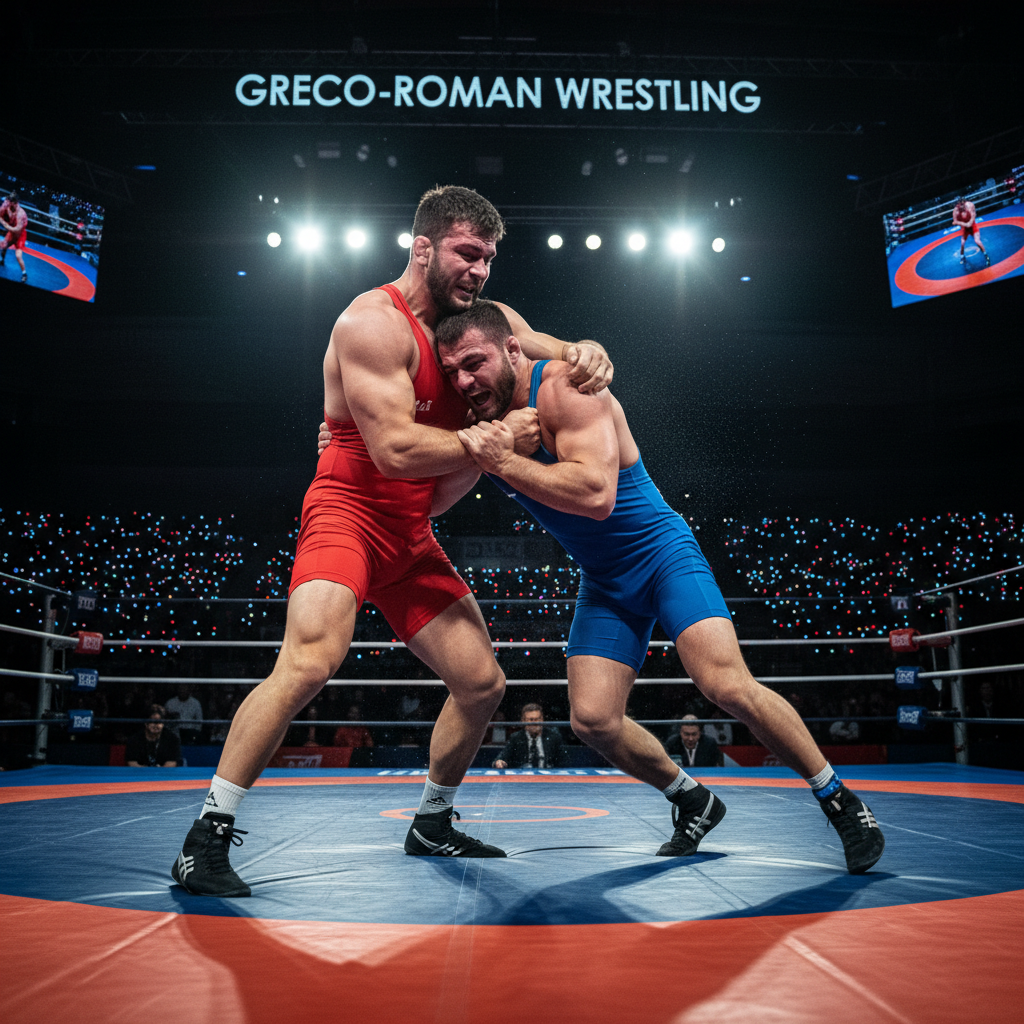
Greco-Roman wrestling stands as one of the oldest and most prestigious combat sports in human history, serving as a cornerstone of the modern Olympic Games. Unlike its counterpart, freestyle wrestling, Greco-Roman strictly forbids holds below the waist, creating a unique dynamic that emphasizes upper-body strength, explosive power, and leverage. This restriction forces athletes to engage in close-quarters combat, often resulting in spectacular throws and high-amplitude slams that define the aesthetic of the sport.
While the name implies a direct lineage to ancient Greece and Rome, the style as we know it today was actually formalized in 19th-century France. Originally termed "flat hand wrestling," it was developed by Napoleonic soldiers who sought to recreate the grappling styles depicted in ancient classical art. The term "Greco-Roman" was adopted to lend the sport an air of historical nobility, connecting the modern athlete to the warriors of antiquity, even though the ancient Greeks actually allowed leg holds in their version of wrestling known as pale.
The Fundamental Rules and Restrictions
The defining characteristic of Greco-Roman wrestling is the absolute prohibition of attacking the legs or using the legs to execute a takedown. In freestyle wrestling, a double-leg takedown is a staple move; in Greco-Roman, touching the opponent’s legs with your hands or using your own legs to trip or hook is an immediate foul. This rule fundamentally changes the center of gravity and the stance of the wrestlers. Competitors must stand more upright to generate leverage from the chest and hips, rather than the crouched, defensive posture often seen in freestyle.
Scoring in Greco-Roman is designed to reward aggression and high-impact maneuvers. Points are awarded for takedowns, reversals, and exposing the opponent’s back to the mat. The most points are awarded for "grand amplitude" throws, where a wrestler lifts their opponent completely off the mat and throws them through a large arc, landing them in a danger position. These moves, such as the suplex, are not only high-scoring but are also crowd favorites due to their visual intensity and the sheer strength required to execute them.
The Importance of Par Terre
Because takedowns can be difficult to secure when leg attacks are banned, much of the scoring in Greco-Roman wrestling occurs on the ground, a position known as par terre. When a wrestler is penalized for passivity—failing to engage or attack—they are often ordered to the ground, giving their opponent a distinct advantage. The top wrestler is allowed to lock their hands around the bottom wrestler’s torso to attempt a turn or throw, while the bottom wrestler must defend by flattening out and preventing the lift.
One of the most common and effective moves from the par terre position is the gut wrench. In this technique, the top wrestler wraps their arms around the opponent’s waist, squeezing tight to eliminate space. By rolling their own body and using the momentum of their hips, they force the opponent to rotate across their back, exposing their shoulders to the mat. Repeated gut wrenches can end a match quickly via technical superiority, making it a bread-and-butter technique for elite wrestlers.
Techniques of the Standing Position
In the standing position, the battle is primarily for underhooks and body locks. An underhook involves digging an arm under the opponent’s armpit to control their shoulder and upper body. Securing double underhooks allows a wrestler to close the distance and lock their hands around the opponent’s back or chest. From this dominant position, a wrestler can attempt a body lock throw, using their hips as a fulcrum to launch the opponent over their head or to the side.
Another critical standing technique is the arm drag. Since wrestlers cannot dive for legs, they must find ways to flank their opponent. An arm drag involves gripping the opponent’s tricep or wrist and pulling it across the body while stepping to the outside. This momentary angle allows the attacker to move behind the opponent for a takedown or to transition into a lift. The speed and precision required for an arm drag highlight that Greco-Roman is not just about brute force, but also about timing and misdirection.
Physical Demands and Conditioning
The physical attributes required for Greco-Roman wrestling are distinct from other combat sports. While cardiovascular endurance is essential, the sport places a premium on isometric strength and core stability. Wrestlers must be able to hold a locked position against a resisting opponent for extended periods. Furthermore, neck strength is paramount; wrestlers often use their heads as a fifth limb for positioning and must be able to bridge on their necks to avoid being pinned.
Training regimens for Greco-Roman athletes are grueling. They include heavy compound lifts such as deadlifts, squats, and cleans to build the posterior chain power necessary for lifting heavy opponents. Additionally, specific drills like rope climbing and weighted pull-ups are utilized to develop the crushing grip strength needed to maintain holds. Flexibility, particularly in the back and hips, is also crucial to execute arches during throws and to defend against being turned on the mat.