
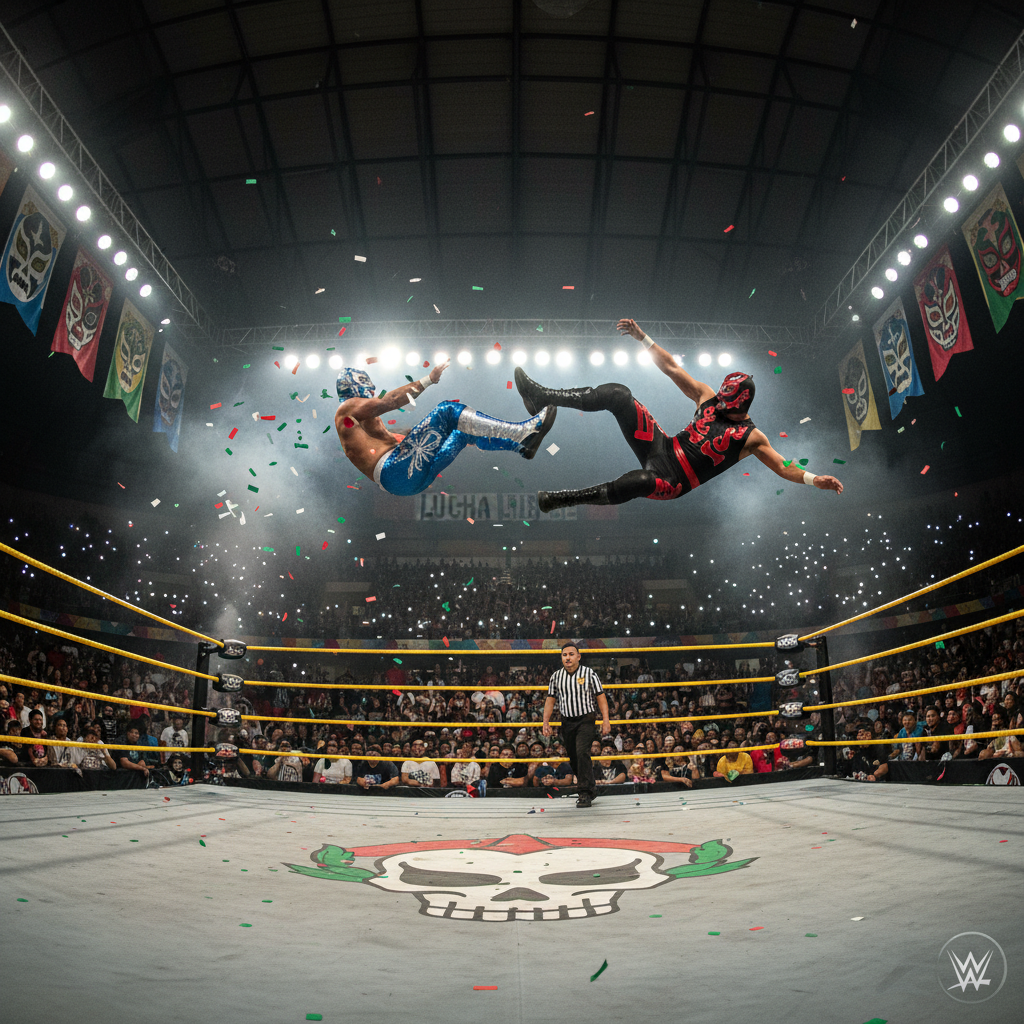
Lucha Libre, which translates literally to “free fight,” is far more than just the Mexican version of professional wrestling. It is a spectacular blend of sport, theater, and cultural heritage that has captivated audiences for nearly a century. Unlike its American counterpart, which often focuses heavily on heavyweight power and microphone skills, Lucha Libre is renowned for its high-flying aerial maneuvers, intricate hold sequences, and, most importantly, the sacred tradition of the mask. To understand Lucha Libre is to understand a vital component of Mexican pop culture, where the lines between mythology and reality blur inside the squared circle.
The Origins of the Squared Circle in Mexico
The history of Lucha Libre formally began in the early 20th century, but it found its true footing in 1933. Salvador Lutteroth González, often referred to as the “Father of Lucha Libre,” founded the Empresa Mexicana de Lucha Libre (EMLL), which is known today as the Consejo Mundial de Lucha Libre (CMLL). Lutteroth was inspired by wrestling matches he witnessed in Texas and decided to bring the spectacle to Mexico City. He established Arena México, which remains the spiritual home and “cathedral” of the sport to this day. His vision transformed a foreign curiosity into a national obsession, laying the groundwork for a unique style that would diverge significantly from the rest of the world.
One of the most defining characteristics of Lucha Libre is the distinction between the two moral alignments of the wrestlers: the técnicos and the rudos. The técnicos are the “good guys,” typically utilizing scientific wrestling moves, high-flying acrobatics, and fighting with honor. In contrast, the rudos are the “bad guys,” or heels, who resort to brawling, cheating, and breaking the rules to achieve victory. This binary morality play is essential to the storytelling of Lucha Libre, representing a constant battle between good and evil that resonates deeply with the working-class audience that traditionally fills the arenas.
The Sacred Mask
Perhaps no element is more synonymous with Lucha Libre than the mask, or la máscara. While masks have been used in wrestling elsewhere, nowhere do they hold the same cultural weight as in Mexico. The mask is not merely a costume; it is the wrestler’s identity, soul, and honor. Historically linked to Aztec and Mayan masked rituals, the modern luchador’s mask transforms an ordinary citizen into a superhuman character. When a luchador puts on the mask, they adopt a persona that is often treated with more reverence than their real-life identity. For many famous luchadores, they are never seen in public without their masks, maintaining the mystery until their dying day.
The most legendary figure in the history of Lucha Libre is undoubtedly El Santo (The Saint). Debuting in the 1940s, El Santo transcended the sport to become a folk hero and a movie star. He starred in over 50 films where he fought vampires, mummies, and mad scientists, always fighting for justice. El Santo was never unmasked in the ring and was buried wearing his iconic silver mask. His legacy solidified the luchador as a symbol of justice in the Mexican imagination, paving the way for other legends like Blue Demon and Mil Máscaras, who together form the “Big Three” of the golden age of Lucha Libre.
Because the mask is so sacred, the ultimate humiliation and the highest stake in Lucha Libre is the Lucha de Apuestas, or “betting match.” In these matches, wrestlers wager their most prized possessions. The most dramatic is máscara contra máscara (mask vs. mask), where the loser must unmask in the center of the ring, reveal their real name, and retire that masked persona forever. For unmasked wrestlers, the wager is usually cabellera contra cabellera (hair vs. hair), where the loser has their head shaved bald. These matches draw the largest crowds and generate the most emotion, often far exceeding the importance of championship belts.
High-Flying Acrobatics and Tag Team Rules
The in-ring style of Lucha Libre is distinctively faster and more acrobatic than American wrestling. This style, known as the “lucha” style, emphasizes agility over brute strength. Luchadores perform breathtaking dives out of the ring, known as topes, and complex aerial maneuvers like the hurricanrana (originally the huracánrana, named after its inventor Huracán Ramírez). The rings in Mexico are generally stiffer, yet the wrestlers perform rolls and bumps that require immense athletic conditioning to avoid injury while maintaining a rapid pace.
Tag team wrestling in Mexico also operates under a unique set of rules, most commonly in the Trios format (three against three). In a standard trios match, each team has a designated captain. To win a fall, a team must either pin the opposing captain or pin both of the other two team members. This rule structure encourages fast-paced action and frequent tagging, allowing for chaotic and exciting sequences that differ from the standard two-on-two tag matches seen in the WWE or other international promotions.
Another fascinating subculture within Lucha Libre is the presence of the Exóticos. These are male wrestlers who perform in drag or adopt effeminate personas, often incorporating campy theatrics and kissing their opponents to distract them. While initially presented as comic relief, many Exóticos, such as Cassandro and Pimpinela Escarlata, have gained massive respect for their legitimate wrestling skills and toughness. They challenge traditional concepts of machismo in Mexican culture, becoming beloved fan favorites who can hold their own against the toughest rudos.
Similarly, the division of the Mini-Estrellas is a unique aspect of the sport. Unlike “midget wrestling” in the United States, which was historically treated as a sideshow, the Mini-Estrellas in Mexico are respected athletes who function as a smaller-scale version of the main roster. They often mirror popular larger wrestlers (mascotas) or have their own unique characters. They are known for their incredible speed and ability to perform maneuvers that larger wrestlers cannot, and they have their own championships and dedicated fan bases.
Women in the Ring
Women’s wrestling, or Lucha Femenil, has a long and complicated history in Mexico. While women were banned from wrestling in Mexico City for decades during the mid-20th century due to conservative laws, they continued to perform in other states. Since the ban was lifted in the 1980s, luchadoras like Faby Apache, Lady Shani, and Marcela have risen to prominence. Today, female matches are often just as technical and hard-hitting as the men’s matches, and women frequently main-event major shows, commanding respect and admiration from the audience.
The modern era of Lucha Libre is dominated by two major promotions: the traditional CMLL (Consejo Mundial de Lucha Libre) and the edgier AAA (Lucha Libre AAA Worldwide). CMLL preserves the classic traditions, focusing on technical wrestling and maintaining the sanctity of Arena México. AAA, founded in 1992, adopted a more Americanized production style with dramatic storylines, entrance music, and spectacular light shows. The rivalry between these two organizations has fueled the industry for decades, offering fans different flavors of the same beloved sport.
Lucha Libre’s influence has spread globally, significantly impacting professional wrestling in the United States and Japan. In the 1990s, American promotions like WCW imported luchadores such as Rey Mysterio Jr., Eddie Guerrero, and Psychosis, who introduced mainstream American audiences to the high-flying style. This led to the creation of cruiserweight divisions and permanently altered the pacing of modern wrestling. Today, the influence is undeniable, with the mask and the aerial moves being staples in wrestling promotions around the world.
Attending a live Lucha Libre event is a sensory experience unlike any other. The atmosphere is raucous, with vendors selling beer and snacks (like cueritos and popcorn) moving through the aisles while the crowd chants and blows horns. The audience interaction is integral; the crowd is not a passive observer but an active participant in the drama. Insults are hurled at the rudos, and cheers uplift the técnicos. It is a cathartic release for the spectators, a place where they can scream, laugh, and cry along with the action in the ring.
In conclusion, Lucha Libre is an intangible cultural heritage of Mexico. It combines the athleticism of Olympic sport with the drama of a telenovela and the visual spectacle of a comic book. From the humblest local gymnasiums to the grand stage of Arena México, the spirit of Lucha Libre endures because it speaks to universal themes of heroism, villainy, and the mystery behind the mask. It remains a vibrant, living tradition that continues to evolve while honoring the legends of the past.