NCAA wrestling stands as one of the most physically demanding and historically significant sports in the American collegiate system. Unlike many other varsity sports, wrestling requires an unparalleled combination of cardiovascular endurance, explosive power, technical precision, and mental fortitude. It is a sport where individual accountability is absolute; once a wrestler steps inside the circle, there are no teammates to pass the ball to and no timeouts to hide behind. The National Collegiate Athletic Association (NCAA) oversees the sport across three divisions, with Division I representing the pinnacle of competition where future Olympians and MMA champions are often forged.
Understanding Collegiate Folkstyle
The style of wrestling practiced in the NCAA is known as folkstyle or collegiate wrestling, which differs significantly from the freestyle and Greco-Roman styles seen in the Olympic Games. While international styles prioritize exposure points and high-amplitude throws, folkstyle places a heavy emphasis on control. The ultimate goal is to pin the opponent’s shoulders to the mat, but the strategic battle often revolves around controlling the opponent on the ground. This rule set encourages athletes to master the art of riding (maintaining control from the top position) and escaping (getting away from the bottom position), adding a tactical layer of ground warfare unique to the American system.
Scoring in NCAA wrestling is dynamic and has evolved to encourage offensive action. The most significant recent change was the adjustment of the takedown score from two points to three points, a rule implemented to reward wrestlers who aggressively pursue offensive attacks. Other scoring methods include the escape (1 point), the reversal (2 points), and the near-fall or back points (2, 3, or 4 points depending on duration). Additionally, a unique feature of folkstyle is the "riding time" point, awarded at the end of a match to a wrestler who has accumulated one minute or more of net advantage time in the top position, further incentivizing mat control.
The Ten Weight Classes
To ensure fair competition, NCAA wrestling is divided into ten specific weight classes. In Division I, these classes are 125, 133, 141, 149, 157, 165, 174, 184, 197, and the heavyweight division, which is capped at 285 pounds. Athletes must maintain strict discipline regarding their diet and hydration to compete at their optimal weight. The strategy of "cutting weight"—temporarily shedding water weight to compete in a lower class—has historically been a controversial aspect of the sport. However, the NCAA has implemented rigorous weight management programs, including hydration testing and body fat assessment at the beginning of the season, to prevent dangerous weight loss practices and ensure athlete safety.
The competitive season is structured around two distinct formats: dual meets and tournaments. A dual meet features two teams facing off head-to-head across all ten weight classes. Each individual match contributes to the team score, with bonus points awarded for dominant performances such as major decisions (winning by 8-14 points), technical falls (winning by 15+ points), and pins (fall). This format creates an exciting team atmosphere where a single wrestler’s performance can decide the outcome of the entire meet. Conversely, tournaments involve multiple teams and brackets for each weight class, testing an individual’s endurance as they may wrestle up to five or six times in a single weekend.
The Powerhouse Programs
Historically, NCAA wrestling has been dominated by a select few programs, often referred to as "Blue Bloods." Oklahoma State University holds the record for the most team national championships, a testament to their century-long tradition of excellence. The University of Iowa, particularly under the legendary coaching of Dan Gable, revolutionized the sport with a high-intensity, physical style that defined wrestling in the 1970s, 80s, and 90s. In the modern era, Penn State University, led by Cael Sanderson, has established a dynasty, shattering scoring records and producing champions at an unprecedented rate. These rivalries, particularly between Iowa and Penn State, drive massive attendance and viewership.
The regular season culminates in the Conference Championships, where wrestlers compete to secure automatic bids to the national tournament. Conferences like the Big Ten and the Big 12 are considered the gauntlets of the sport, often featuring brackets that are nearly as difficult as the national tournament itself. Success at the conference level is crucial not only for qualification but also for seeding at the NCAA Championships. A high seed rewards a wrestler with a theoretically easier path through the early rounds, although upsets are a hallmark of collegiate wrestling.
March Matness: The NCAA Championships
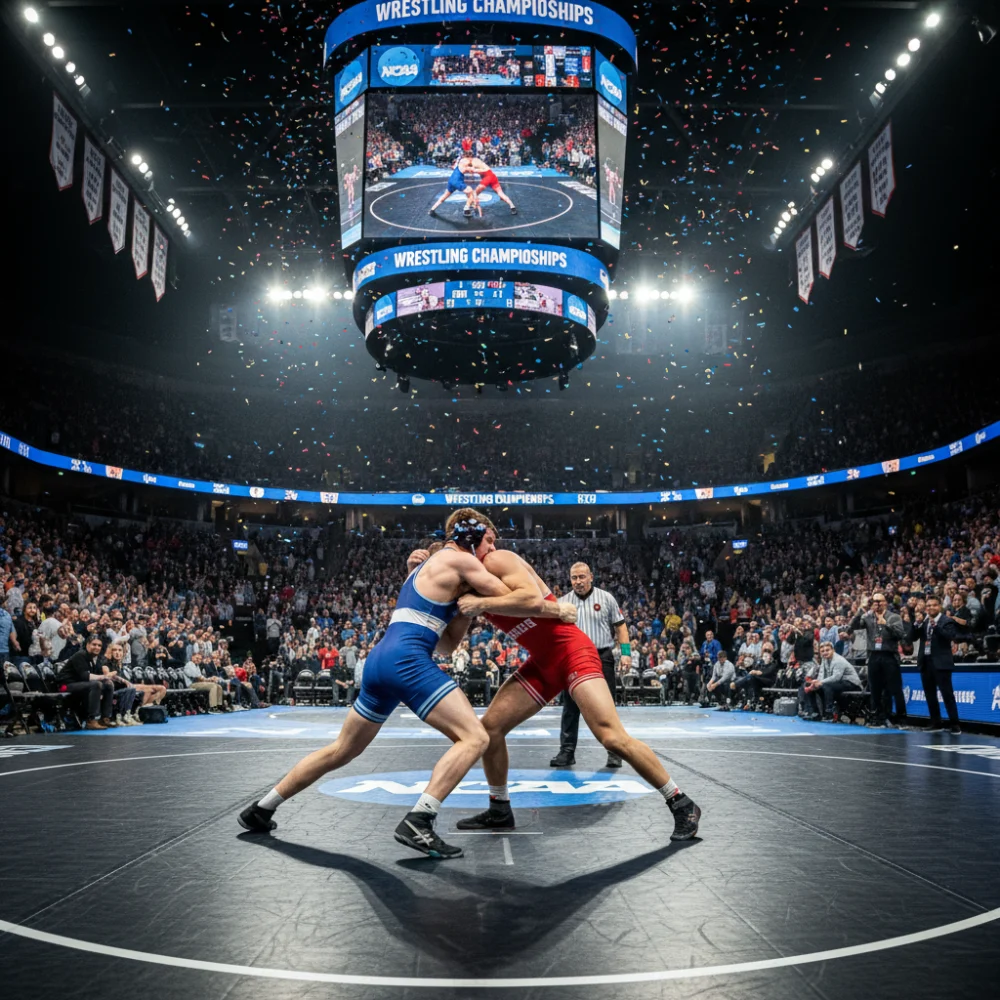
The NCAA Division I Wrestling Championships is the premier event of the season, often referred to as "March Matness." Held over three days in large arenas, the tournament features 330 wrestlers (33 per weight class) battling for the title of National Champion. The atmosphere is electric, with simultaneous matches occurring on eight mats during the early rounds. The top eight finishers in each weight class earn the coveted status of All-American, an honor that cements a wrestler’s legacy in their program’s history books.
Team scoring at the NCAA Championships differs from dual meets. Teams accumulate points based on the advancement of their individual wrestlers through the championship and consolation brackets, along with bonus points for pins and dominance. This means a team does not necessarily need a wrestler in every final to win the team title; they need a collection of athletes who can score bonus points and place high on the podium. This scoring system adds a layer of complexity for coaches, who must prepare every qualifier to contribute to the team total, regardless of whether they are contending for first place.
Individual Legends and the Dan Hodge Trophy
While team titles are prestigious, individual greatness is celebrated through the Dan Hodge Trophy, essentially the Heisman Trophy of wrestling. It is awarded annually to the nation’s most dominant wrestler. Legends like Cael Sanderson, who went 159-0 in his college career at Iowa State, and Kyle Dake of Cornell, who won four national titles in four different weight classes, are past recipients. These athletes often transcend the sport, setting standards of perfection that future generations strive to emulate.
The transition from NCAA folkstyle to international freestyle is a critical juncture for elite wrestlers with Olympic aspirations. While the skill sets overlap, the rules are different enough that success in college does not guarantee success on the world stage. However, the United States has successfully used the NCAA system as a feeder for its Olympic team. High-level collegiate programs essentially function as Regional Training Centers (RTCs), where collegiate athletes train alongside post-graduate Olympians, creating an ecosystem of continuous development that benefits both the college teams and Team USA.
The Role of Recruiting
Recruiting in NCAA wrestling is fiercely competitive. Coaches scout talent at major high school tournaments like the Fargo Nationals and the Super 32. Unlike football or basketball, wrestling scholarships are limited; Division I programs are allowed only 9.9 scholarships to distribute across a roster of 30+ athletes. This scarcity forces coaches to be strategic, often breaking up scholarships into partial awards. Consequently, many college wrestlers are walk-ons or on partial aid, driven by passion and the desire to compete at the highest level rather than financial incentives.
Geography plays a massive role in the sport’s culture. States like Pennsylvania, Ohio, Iowa, New Jersey, and Oklahoma are considered the heartland of wrestling. These regions produce a disproportionate number of NCAA qualifiers and champions. The wrestling culture in these areas is ingrained in the community, with youth programs feeding into high schools and eventually into major universities. The fanbase in these regions is incredibly knowledgeable and passionate, often selling out dual meets and traveling in droves to the National Championships.
The Rise of Women’s Wrestling
A significant development in the collegiate landscape is the explosive growth of women’s wrestling. While historically not an NCAA championship sport, it has recently been designated as an Emerging Sport for Women by the NCAA across all three divisions. This status is a precursor to becoming a fully sanctioned championship sport. Programs are springing up nationwide, providing female athletes with varsity opportunities and scholarships. This growth is expanding the sport’s reach and ensuring that wrestling becomes a more inclusive discipline at the collegiate level.
Looking toward the future, NCAA wrestling faces both challenges and opportunities. The introduction of Name, Image, and Likeness (NIL) deals has begun to impact recruiting and retention, allowing top wrestlers to monetize their success. Furthermore, conference realignment threatens to disrupt traditional rivalries, potentially consolidating power into fewer super-conferences. Despite these shifts, the core of the sport remains unchanged: two athletes, a circle, and a battle of wills. The dedication required to survive a Division I wrestling season ensures that the sport remains a proving ground for character, discipline, and physical excellence.