Wrestling stands as one of the oldest and most primal forms of athletic competition known to humanity, serving as a cornerstone of the Olympic Games since antiquity. As a sport that requires zero equipment beyond the athletes’ bodies and a mat, it represents the purest test of strength, agility, and tactical intelligence. In the modern Olympic program, wrestling is governed by United World Wrestling (UWW) and is divided into two distinct disciplines: Greco-Roman and Freestyle. While both styles share the ultimate goal of pinning an opponent to the mat, they differ significantly in their rules regarding the use of legs and hold restrictions, creating two unique strategic landscapes for competitors.
The Ancient Origins and Modern Revival
The history of wrestling dates back millennia, with cave drawings in France and Egypt depicting grappling techniques as early as 3000 BC. However, its most prestigious historical association is with the Ancient Olympic Games in Greece, where it was introduced in 708 BC. Ancient Greek wrestling, or Palé, was highly revered and served as the decisive event of the Pentathlon. It was not merely a sport but a martial art used to train soldiers for hand-to-hand combat. When the modern Olympic Games were revived in Athens in 1896, wrestling was a natural inclusion, emphasizing the continuity between the ancient and modern eras. Since then, it has appeared in every Summer Olympics with the sole exception of the 1900 Paris Games.
Understanding the Two Styles: Freestyle vs. Greco-Roman
The primary distinction between the two Olympic styles lies in the legal use of the legs. In Greco-Roman wrestling, athletes are strictly forbidden from holding their opponent below the waist or using their own legs to trip, hook, or lift the opponent. This restriction forces Greco-Roman wrestlers to rely entirely on upper-body strength, leverage, and explosive throws. The result is a style characterized by close-quarters pummeling, high-amplitude suplexes, and dramatic chest-to-chest combat. It is often described as a battle of sheer power and positioning.
Conversely, Freestyle wrestling allows the use of the wrestler’s own legs and attacks on the opponent’s legs. This opens up a vast array of offensive and defensive techniques, including double-leg takedowns, single-leg snatches, and ankle picks. Because the entire body is a target, Freestyle matches tend to be faster-paced and feature lower stances as athletes protect their legs from attack. While Greco-Roman emphasizes upright clinching and throws, Freestyle emphasizes speed, level changes, and complex scrambling on the mat.
The Rise of Women’s Wrestling
For over a century, Olympic wrestling was exclusively a male domain. This changed dramatically at the 2004 Athens Games with the introduction of women’s wrestling. Unlike the men, who compete in both styles, women compete exclusively in Freestyle wrestling at the Olympic level. The inclusion of women has significantly expanded the sport’s global reach and popularity. Japan has emerged as the undisputed powerhouse in women’s wrestling, led by legendary athletes like Kaori Icho and Saori Yoshida, who have set records for dominance that rival any athlete in any sport.
Scoring and the Objective of the Match
The ultimate way to win a wrestling match is by pinfall (or a “fall”). A pin occurs when a wrestler holds both of their opponent’s shoulder blades against the mat simultaneously for a specific duration (usually about one second), leading to an immediate victory regardless of the current score. However, at the elite Olympic level, pins are relatively rare due to the high skill level of the competitors. Consequently, most matches are decided by points accumulated through technical execution over two three-minute periods.
The Point System Explained
Points are awarded for various maneuvers based on the level of control and the amplitude of the action. A standard takedown, where a wrestler takes their opponent to the mat and establishes control, is typically worth two points. If a wrestler throws their opponent with high amplitude (lifting them completely off the mat so their feet go over their head) and lands them in a danger position, they can be awarded four or even five points. Reversals, where a defensive wrestler gains control over the attacker, are worth one point. Additionally, points are awarded for “exposure,” which involves turning the opponent’s back toward the mat without securing a pin.
Technical Superiority and Passivity
Aside from a pin or a points decision at the end of time, a match can end early via Technical Superiority. This is similar to the “mercy rule” in other sports. In Freestyle wrestling, a lead of 10 points constitutes a technical superiority victory. In Greco-Roman, an 8-point lead ends the match. This rule encourages aggressive wrestling and prevents prolonged mismatches. Furthermore, referees strictly penalize passivity. If a wrestler is stalling or refusing to engage, they are placed on a “shot clock” (in Freestyle) or forced into a disadvantaged position (Par Terre) in Greco-Roman, ensuring the action remains continuous.
The Field of Play: The Wrestling Mat
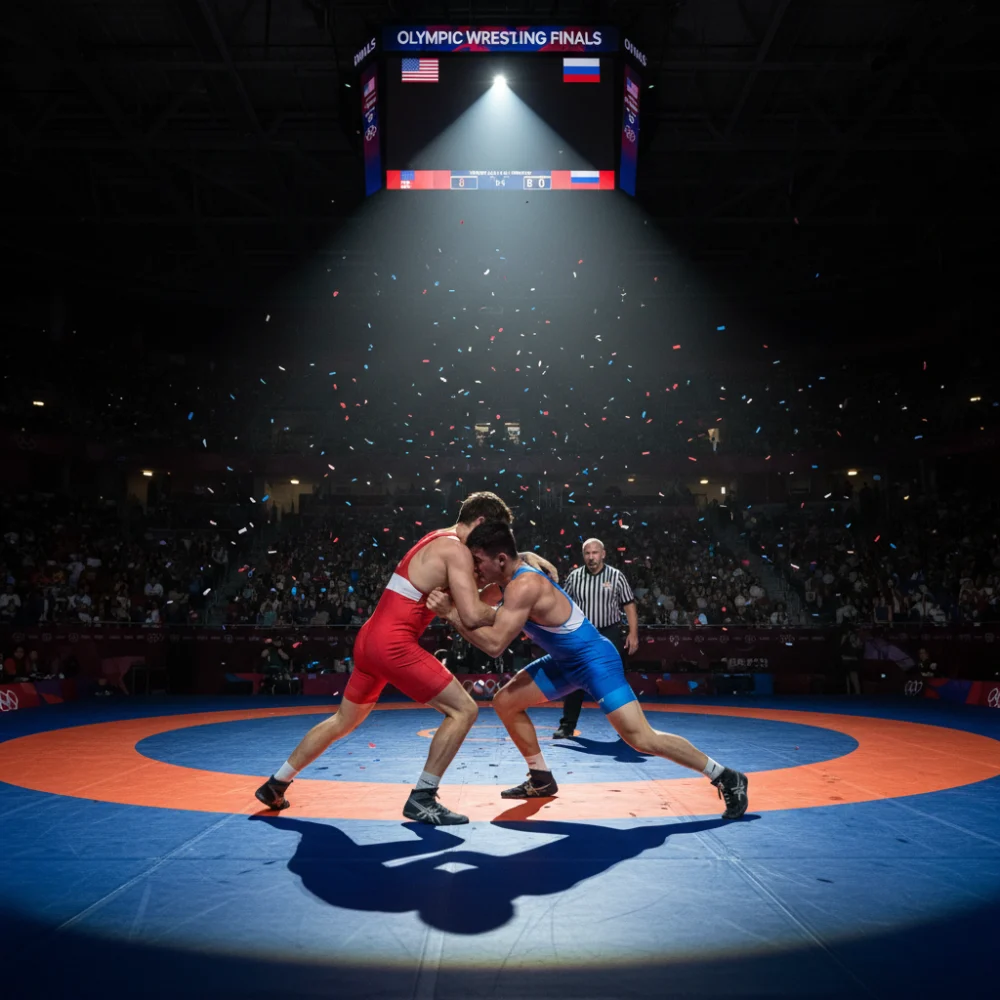
Olympic wrestling takes place on an octagonal or square mat containing a distinct circular wrestling area. The central circle, known as the Center of the Mat, is 7 meters in diameter. Surrounding this is a 1-meter wide orange band called the Zone. This zone serves as a warning track; stepping out of bounds results in a stoppage and often a point awarded to the opponent. The mat surface is designed to provide shock absorption to protect athletes during high-impact throws while offering enough friction to allow for explosive movements without slipping.
Weight Classes and Weigh-ins
To ensure fair competition, wrestlers compete in specific weight categories. These classes have evolved over the years to reflect the changing physical profiles of athletes. Currently, there are six Olympic weight classes for Men’s Freestyle, six for Men’s Greco-Roman, and six for Women’s Freestyle. Athletes must manage their weight meticulously, often engaging in “weight cutting” to compete in a lower class where they might have a size advantage. However, UWW has implemented stricter weigh-in procedures, including weigh-ins on the morning of the competition, to discourage extreme dehydration and promote athlete health.
Equipment: Simplicity and Function
Wrestling requires minimal equipment, emphasizing the body’s natural capabilities. The primary uniform is the singlet, a one-piece tight-fitting garment typically made of Lycra or Spandex. One wrestler wears red and the other blue to allow referees and spectators to distinguish between them easily. The most critical piece of equipment is the wrestling shoe. These shoes are high-tops designed to provide ankle support and feature thin rubber soles for maximum grip on the mat. Unlike boxing or MMA, no gloves or protective padding are worn, although ear guards (headgear) are optional to prevent auricular hematoma, commonly known as “cauliflower ear.”
Global Powerhouses and Rivalries
The geopolitical landscape of Olympic wrestling is fierce and historically significant. The Russian Federation (and formerly the USSR) has historically been the dominant force, producing countless champions in both Freestyle and Greco-Roman. The United States is a major powerhouse in Freestyle, known for a gritty, conditioning-heavy style. Iran considers wrestling its national sport, producing highly technical and passionate competitors. In recent years, nations like Cuba (Greco-Roman), Japan (Women’s Freestyle and lighter men’s weights), and former Soviet bloc countries like Georgia and Azerbaijan have consistently reached the podium, making the sport truly global.
The 2013 Crisis and Modernization
In February 2013, the International Olympic Committee (IOC) shocked the sports world by voting to recommend dropping wrestling from the 2020 Olympic program. The decision was based on stagnant TV ratings, lack of gender equality, and complex rules. This existential threat triggered a massive global campaign titled “Save Olympic Wrestling.” Unprecedented cooperation occurred between political adversaries like the USA, Iran, and Russia to lobby for the sport’s reinstatement. The governing body (then FILA) underwent a major overhaul, rebranding as United World Wrestling, changing the rules to encourage more scoring, and adding more weight classes for women.
The Reinstatement and Future Outlook
The reforms were successful, and wrestling was voted back into the Olympic program just months later. Since then, the sport has embraced modernization. The rule changes shifted the focus from pushing opponents out of bounds to executing active takedowns, making matches more viewer-friendly. The presentation of the sport has also improved, with better lighting, camera angles, and the introduction of a video challenge system (VAR) where coaches can throw a “brick” (usually a soft foam object) to contest a referee’s call. These changes have secured wrestling’s place in the Olympics for the foreseeable future.
Physical and Mental Demands
Wrestling is widely considered one of the most physically demanding sports in the Olympic repertoire. It requires a unique blend of anaerobic power, aerobic endurance, explosive strength, and extreme flexibility. A typical match involves six minutes of constant tension, pushing and pulling against a resisting opponent of equal weight. Mentally, it is isolating; there are no teammates to pass the ball to when tired. The psychological resilience required to endure the training camps, the weight cuts, and the solitary pressure of the mat makes wrestlers some of the most disciplined athletes in the world.