
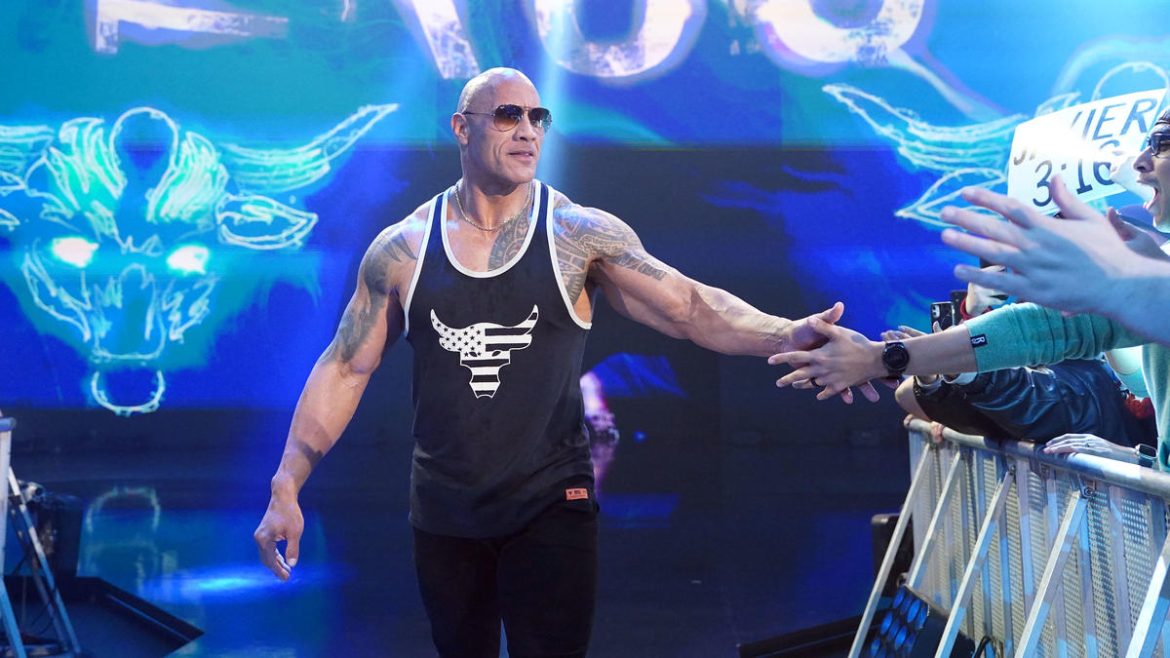
The annals of sports entertainment are replete with individuals who transcend their initial arenas, forging remarkable careers beyond the bright lights and roaring crowds. However, few have achieved the seismic impact and enduring global adoration that Dwayne "The Rock" Johnson has, navigating a transition from the hyperbolic world of professional wrestling to the dazzling, yet often unforgiving, landscape of Hollywood. It’s a journey that, in retrospect, seems almost predestined, yet Johnson himself attributes the genesis of this monumental shift to a confluence of ambition, a burning desire for personal growth, and a pivotal, albeit challenging, cinematic debut that ignited an unexpected passion. His recent reflections, shared during an engaging appearance at The Hollywood Reporter’s Actor Roundtable, offer a candid glimpse into the mindset that propelled him from being "The People’s Champion" to one of the planet’s most bankable movie stars.
Johnson’s WWE career, which began in the mid-1990s, was nothing short of spectacular. Emerging from the legendary Anoa’i wrestling family, he quickly distinguished himself from his contemporaries. His natural charisma, combined with a formidable physique and an innate understanding of crowd psychology, allowed him to evolve from a clean-cut babyface into the smarmy, electrifying "The Rock." He became a master of the microphone, crafting catchphrases that echoed in arenas worldwide and engaging in legendary rivalries with icons like Stone Cold Steve Austin, Triple H, and Mick Foley. His signature blend of bravado, wit, and athletic prowess made him a cornerstone of WWE’s "Attitude Era," a period characterized by edgy storylines and unprecedented popularity. By the early 2000s, The Rock was not merely a wrestling superstar; he was a cultural phenomenon, a larger-than-life persona whose influence extended far beyond the squared circle.
The decision to pivot towards acting wasn’t a sudden whim, but rather a calculated, albeit somewhat organic, evolution. Johnson has articulated a deep-seated belief in the concept of destiny, a notion that the universe conspires to guide individuals toward their true paths. Yet, he is also a pragmatist, a man who understands the importance of seizing opportunities and actively shaping one’s future. His transition to Hollywood was fueled by an intrinsic need to challenge himself, to step outside his comfort zone and explore new creative territories. Wrestling, while demanding, operates within a defined framework. Acting, conversely, presents a vast, uncharted expanse of artistic expression, a prospect that clearly resonated with Johnson’s ambitious spirit. He sought to prove his versatility, to demonstrate that the captivating performer audiences saw in the wrestling ring possessed a depth and range that could translate to the dramatic and comedic arts.

His maiden voyage into the cinematic world was the 2001 blockbuster "The Mummy Returns." This was not a minor role; Johnson was cast as the Scorpion King, a formidable antagonist destined to become a central figure in a potential spin-off franchise. The filming location itself presented an immediate and formidable obstacle: the harsh, unforgiving deserts of Morocco. Johnson recounted the extreme conditions, vividly describing being struck down by illness. The scorching Saharan heat, a stark contrast to the controlled environment of a wrestling arena, exacerbated his sickness. He vividly remembers the intense 110-degree Fahrenheit temperatures, a stark reminder of the physical toll the production was taking, even before he had truly begun to act. The irony was not lost on him – battling a severe bout of food poisoning in one of the world’s most challenging environments.
It was during a particularly arduous day of shooting, while grappling with his illness, that the spark of his acting passion was truly ignited. Director Stephen Sommers approached him, concerned about his well-being. Johnson, ever the professional, insisted he was ready to perform. As the cameras rolled and the director called for "action," he delivered his lines and performed his scenes, pushing through the physical discomfort. However, it was in the moments after the director yelled "cut" that a profound realization dawned upon him. The process, the collaborative effort, the sheer act of embodying a character and conveying emotion, resonated with him on a fundamental level. He felt an overwhelming sense of purpose, an electrifying realization that this was more than just a temporary diversion; this was a calling. In that moment, amidst the arid expanse of the Sahara, Dwayne Johnson discovered a new passion, a desire that he declared would define the rest of his professional life.
From that pivotal moment in 2001, Johnson’s ascent in Hollywood has been nothing short of meteoric. He has amassed an impressive filmography, appearing in nearly 50 feature films across a diverse spectrum of genres. His roles have ranged from significant supporting parts and charismatic leads to vocal performances in animated features, demonstrating a remarkable ability to adapt and captivate audiences in various capacities. He has navigated the demanding schedules of blockbuster productions, often juggling multiple high-profile projects simultaneously, a testament to his work ethic and the immense demand for his presence. His film choices have often leaned into action and adventure, leveraging his imposing physique and undeniable screen presence, but he has also shown a knack for comedy and even ventured into more dramatic territory, proving his versatility.
The impact of his wrestling persona on his acting career is undeniable. The charisma, the larger-than-life presence, and the exceptional ability to connect with an audience that made him a wrestling icon proved to be incredibly transferable assets to the film industry. He brought a unique brand of energy and a built-in fanbase that studios were eager to capitalize on. However, Johnson has consistently strived to evolve beyond the shadow of "The Rock," meticulously selecting roles that allow him to showcase different facets of his acting talent. He has demonstrated a keen understanding of the industry, building strategic relationships and consistently making choices that have propelled him upward.

His journey also highlights a significant trend in the entertainment industry: the increasing crossover appeal of athletes and performers from other high-profile entertainment sectors. Wrestlers, in particular, possess a unique skill set – stage presence, physical conditioning, the ability to memorize lines and execute physical choreography, and a deep understanding of storytelling and audience engagement. This combination has made them attractive prospects for filmmakers looking for stars with a proven ability to command attention. Johnson, however, has elevated this crossover to an entirely new level, transcending the initial novelty to become a genuine Hollywood heavyweight, respected for his craft and business acumen.
The narrative of Dwayne Johnson’s transition is not just a story of one man’s successful career change; it is a compelling illustration of how passion, perseverance, and a willingness to embrace the unknown can lead to extraordinary achievements. His early experiences, fraught with challenges like illness and the sheer unfamiliarity of the acting craft, served not as deterrents but as catalysts. They forged a resilience and a clarity of purpose that have served him exceptionally well. The "acting bug," as he described it, was not a fleeting infatuation but a deep-seated revelation that reshaped his professional trajectory entirely.
Looking back, it’s easy to see the threads connecting the electrifying performer of WWE to the global movie star he is today. Both demand an unwavering commitment to entertaining, a profound understanding of the audience, and the ability to deliver memorable moments that resonate long after the show is over. While the stages and the scripts have changed, the core of what makes Dwayne Johnson so captivating remains the same: an unparalleled ability to connect, to command attention, and to leave an indelible mark. His story is a powerful reminder that sometimes, the greatest opportunities lie just beyond the familiar boundaries of our current success, waiting to be discovered by those bold enough to step into the unknown and embrace the challenge.