
The international expansion of World Wrestling Entertainment reached a fever pitch this week as the blue brand crossed the Atlantic to deliver a historic broadcast from the Uber Arena in Berlin, Germany. While the European fans have long been known for their boisterous energy and deep-seated appreciation for the technical nuances of the craft, nobody in attendance could have fully prepared for the seismic shift in the championship landscape that occurred during the closing moments of the January 9, 2026, edition of SmackDown. The evening was defined by a collision of two of the industry’s most prominent titans, culminating in a grueling war of attrition that not only tested the physical limits of the competitors but also reshaped the trajectory of the Undisputed WWE Championship. By the time the final bell echoed through the rafters of the German arena, the reign of the American Nightmare had reached its conclusion, ushered out by the calculated brutality of a man who has spent the last year obsessed with reclaiming his spot at the top of the mountain.
The rivalry between Cody Rhodes and Drew McIntyre has been simmering for months, built upon a foundation of mutual respect that gradually curdled into a bitter, personal animosity. Rhodes, representing the quintessential fighting champion, had navigated countless challenges to maintain his grip on the gold, while McIntyre had transformed into a cynical, battle-hardened veteran who felt the world had conspired against him. To settle their differences, the two were placed into one of the most demanding match structures in professional wrestling history: the Three Stages of Hell. This rare and dangerous stipulation is designed to strip away a wrestler’s endurance and spirit, requiring them to win two out of three falls, with each segment featuring a different set of rules. For the Berlin crowd, the atmosphere was electric, knowing they were about to witness a match type usually reserved for the grandest stages of premium live events.
The first fall was contested under traditional wrestling rules, emphasizing the pure athleticism and grappling prowess of both men. From the opening lock-up, it was clear that McIntyre had arrived in Germany with a singular, violent focus. The Scottish Warrior used his significant size advantage to ground Rhodes early, utilizing heavy strikes and overhead belly-to-belly suplexes that rattled the champion. Despite Rhodes’ signature resilience and his ability to fire back with quick-strike offense like the Disaster Kick and the Cody Cutter, McIntyre seemed to be one step ahead of every maneuver. The first fall reached its climax when McIntyre caught Rhodes mid-air, transitioning a crossbody attempt into a devastating powerbomb. Sensing the momentum was in his favor, McIntyre leveled the champion with a thunderous Claymore Kick, securing the three-count and taking a critical one-to-zero lead in the series.
With the champion now trailing, the match immediately transitioned into the second stage: a Falls Count Anywhere encounter. This shift in rules removed the sanctuary of the ring and allowed the violence to permeate every corner of the Uber Arena. As the action spilled over the barricades and into the sea of fans, the technical precision of the first fall was replaced by raw, unadulterated brawling. The two competitors traded blows near the production area and through the concourse, using the environment as a weapon. Rhodes, knowing his title reign was on the verge of collapse, tapped into a desperate well of energy. The turning point of the second fall occurred near the entrance stage, where a table had been positioned during the melee. In a moment of pure adrenaline, Rhodes managed to hoist the larger McIntyre up and deliver a crashing Cross Rhodes through the wooden structure. The referee counted the pinfall on the arena floor, evening the score at one fall apiece and setting the stage for the final, decisive confrontation.
As the officials worked to clear the wreckage of the second fall, the ominous steel cage began its slow descent from the ceiling. The Third Stage of Hell would take place within the confines of the reinforced structure, where the only way to win was by pinfall, submission, or by escaping the cage entirely. By this point, both Rhodes and McIntyre were visibly exhausted, their bodies battered from the previous two segments of the match. The cage match began with a frantic pace, as both men realized that the person who could find one last burst of strength would walk away with the richest prize in the business. The cage walls were used as instruments of torture, with both men being lawn-darted into the mesh, leaving visible welts and crimson streaks across their skin. The drama intensified with a series of near-falls that left the Berlin audience breathless, as both the champion and the challenger refused to stay down.
However, the narrative of the match took an unexpected and volatile turn just as the finish seemed to be in sight. Throughout the day, whispers had circulated among the wrestling community regarding the presence of Jacob Fatu in Germany. Fatu, the powerhouse of the Bloodline whose path of destruction had been halted months prior due to a significant injury, had been absent from television for quite some time. The internal lore of the storyline suggested that McIntyre himself was responsible for the attack that sidelined the "Samoan Werewolf," a fact that McIntyre had often bragged about during his promos. As the two finalists struggled toward the top of the cage, the lights in the arena flickered, and the menacing figure of Fatu appeared at ringside. With a terrifying display of agility, Fatu scaled the exterior of the cage and forced his way inside, turning the championship bout into a scene of absolute carnage.
Fatu’s motivations were initially unclear, as he began his assault by targeting McIntyre, seemingly seeking retribution for the months of career time he had lost. The powerhouse unleashed a flurry of high-impact strikes and a diving headbutt that left the Scotsman dazed. Yet, the chaos did not stop there. In a shocking twist, Fatu shifted his aggression toward Cody Rhodes, the very man who had been the target of the Bloodline’s ire for the better part of two years. By laying waste to both competitors, Fatu created a vacuum of power and a sense of total uncertainty. The interference left the referee momentarily overwhelmed as the structured match dissolved into a three-way brawl of sorts, though Fatu was not an official participant. The distraction provided by the Samoan’s arrival served as the ultimate catalyst for the finish.
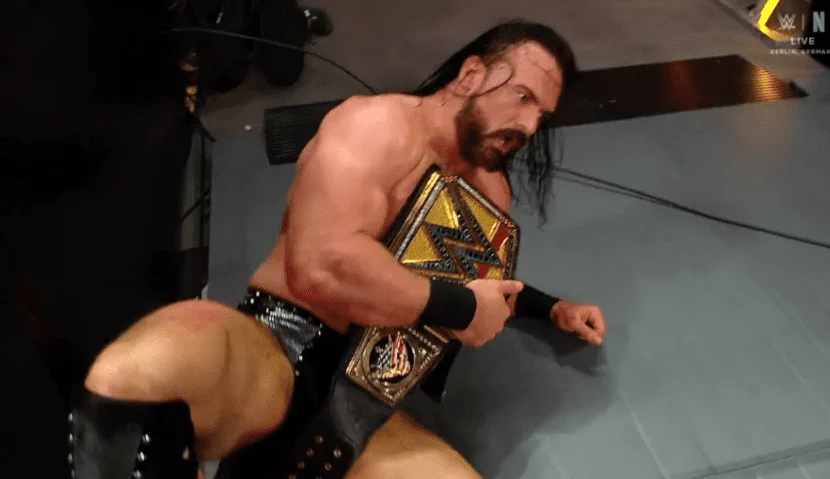
In the midst of the mayhem, McIntyre was able to recover just enough to realize that the door to the cage had been left ajar during the scuffle. While Rhodes was reeling from the impact of Fatu’s blindside attack, McIntyre crawled toward the exit with a look of desperate determination. Despite the interference not being a traditional "help" from an ally, McIntyre exploited the situation with the veteran instincts that have defined his career. As his feet hit the floor on the outside, the referee signaled for the bell, ending the grueling Three Stages of Hell and crowning a new Undisputed WWE Champion. The silence that briefly gripped the Uber Arena was quickly replaced by a mixture of shock and begrudging respect for the new king of the mountain.
Drew McIntyre’s victory in Berlin marks his fourth reign as a world champion, a feat that solidifies his legacy as one of the most successful European imports in the history of the company. For McIntyre, this win is the culmination of a long, arduous journey back to the summit. Since losing his previous titles under various circumstances—including the heartbreak of losing in front of his home crowd in the United Kingdom years prior—McIntyre has reinvented himself as a ruthless pragmatist. This new championship run starts on a foundation of controversy, given the interference of Jacob Fatu, but for the Scottish Warrior, the ends clearly justify the means. He stood on the entrance ramp, clutching the gold to his chest, a look of vindication etched across his face as he stared back at the carnage he left behind in the ring.
The fallout from this match is expected to be massive as WWE moves closer to its spring schedule. For Cody Rhodes, the loss is a devastating blow to a reign that many believed would last well into the next year. Rhodes has been the moral compass of the company, a champion who took on all comers and represented the brand with dignity. Losing the title in such a chaotic fashion, and specifically due to the return of a Bloodline member, raises questions about whether the ghosts of his past rivalries are returning to haunt him. Meanwhile, the return of Jacob Fatu sends a clear message to the entire roster. His presence in Berlin was not merely a cameo; it was a declaration of war against anyone standing in his way, regardless of their alignment.
As the WWE landscape shifts following the events in Germany, the spotlight remains firmly on Drew McIntyre. The new champion now finds himself with a target on his back, not only from a disgruntled Cody Rhodes who will surely demand a rematch, but also from the looming threat of the Bloodline and the unpredictable nature of Jacob Fatu. The Undisputed WWE Championship has a new home, and the "McIntyre Era" has officially begun for the fourth time. Whether he can maintain his grip on the title amidst the rising tide of challengers remains to be seen, but for one night in Berlin, the Scottish Warrior proved that he is willing to endure hell itself to wear the crown. The road ahead is fraught with danger, but as the show went off the air, it was clear that the power dynamics of SmackDown have been irrevocably altered.