The air crackled with anticipation this past Friday night as SmackDown descended upon the Dallas faithful, serving up another vital chapter in the sprawling saga that is the Road to WrestleMania 42. With the Elimination Chamber looming large on the horizon, the pressure on every superstar was palpable, each match, each promo, each fleeting glance carrying immense weight in the grand narrative. This particular evening illuminated the often-complex interplay between championship aspirations, the pursuit of main event glory, and the intricate web of personal rivalries that define professional wrestling’s biggest season. From perplexing tag team title defenses to the relentless march of top contenders, the February 13, 2026, edition of the blue brand proved to be a night where the future was glimpsed, even if not always clearly defined.
The evening kicked off with a segment that, for many, underscored a recurring challenge within the women’s division: the perceived stature of the Women’s Tag Team Championship. The reigning champions, Rhea Ripley and Iyo Sky, found themselves defending their gold against the formidable duo of Nia Jax and Lash Legend. While the match promised a clash of power and agility, the build-up itself felt somewhat muddled, initiated by an unexpected verbal spat between Jax, Legend, and Tiffany Stratton backstage. This seemingly ancillary interaction set the stage for Stratton’s eventual interference, leading to a frustrating no-contest finish just as the contest was beginning to hit its stride. It’s a creative decision that often leaves fans questioning the integrity of the titles themselves, particularly when a clean, decisive outcome is withheld from what could be a compelling championship encounter. The talent involved is undeniable; Ripley and Sky are a dominant, charismatic pairing, while Jax and Legend bring a unique blend of power and presence. Yet, when the narrative arc of a title match is deliberately truncated, it can inadvertently diminish the championship’s importance, especially when the focus immediately shifts to the looming Elimination Chamber event, where singles glory often overshadows tag team accolades. This ongoing struggle to elevate the Women’s Tag Team Championship to a consistent level of prestige remains a significant talking point, and moments like this only reinforce that perception, despite the clear in-ring capabilities of all participants.
Shifting gears from tag team gold to the United States Championship, the narrative continued to explore the complex motivations of those holding, and those aspiring to hold, mid-card titles during WrestleMania season. Carmelo Hayes, the current United States Champion, strode confidently to the ring, his customary swagger on full display. His declaration was bold: he intended to qualify for the Elimination Chamber match, viewing it not as an opportunity to defend his current championship, but as a direct path to the WrestleMania 42 main event. While Hayes’ ambition is commendable and perfectly aligns with his "Him" persona, this explicit prioritization of a world title shot over his current championship can inadvertently cast a shadow over the very gold he holds. It’s a classic dilemma for mid-card champions on the Road to WrestleMania – do they defend their title with pride, or use it as a springboard? Before Hayes could elaborate further, his segment was dramatically interrupted. Solo Sikoa, accompanied by the burgeoning force known as the MFTs (More Fatu Than You), including the recently arrived and highly impactful Tama Tonga, crashed the proceedings. The interruption quickly escalated into a multi-man melee, drawing in other hungry contenders like Ilja Dragunov, Matt Cardona, Apollo Crews, and Shinsuke Nakamura, all vying for recognition. SmackDown General Manager Nick Aldis, ever the astute decision-maker, swiftly adapted to the chaos. He postponed the anticipated Hayes vs. Dragunov championship encounter, instead sanctioning an impromptu 10-man tag team match. While a 10-man spectacle can be exciting, the sudden shift felt like a missed opportunity for a more focused championship story. The subsequent tag match, though delivering some solid action, served primarily to further tease Tama Tonga as a potential United States Championship challenger, a storyline that, despite its potential, felt secondary to Hayes’s stated world title ambitions. The segment highlighted the precarious position of secondary titles when the ultimate prize is within sight, and how even well-intentioned ambition can, at times, inadvertently dilute the significance of the gold already held.
Beyond the championship narratives, SmackDown also showcased the diverse personalities that populate its roster, often through segments that, while not directly tied to title pursuits, contribute significantly to the overall entertainment value. One such moment involved Kit Wilson of Pretty Deadly, whose unique blend of flamboyant heel antics and surprising resilience was on full display. Wilson found himself on the receiving end of a rather uncouth joke from the ever-unpredictable R-Truth, a moment that could have derailed a lesser performer. Yet, Wilson, with his characteristic flair, absorbed the jest with a peculiar grace that only enhanced his character, further cementing Pretty Deadly’s role as one of the most entertaining, if unconventional, acts on the blue brand. It’s a testament to the power of character work, where even a brief, comedic exchange can leave a lasting impression on the audience.
The women’s Elimination Chamber qualifying matches continued apace, with a triple threat contest featuring Alexa Bliss, Giulia, and Zelina Vega. This bout saw Bliss, making a concerted effort to re-establish herself as a dominant force, emerge victorious, securing her spot in the grueling Chamber match. Her "Gal-entine" Charlotte Flair was ringside, offering support, a continued sign of their surprising, yet effective, alliance forged in the wake of the Royal Rumble. While the match itself was a solid, if unspectacular, affair, it effectively advanced the narrative towards the highly anticipated multi-woman clash. However, the broadcast wasn’t without its minor stumbles. A noticeable production error saw Trick Williams’ entrance music prematurely blare during a backstage conversation between Rey Fenix and Sami Zayn. While commentator Wade Barrett admirably attempted to cover the gaffe with a quick-witted remark about Williams’ impatience, such glitches, though small, can momentarily pull viewers out of the immersive experience. Despite the technical hiccup, the focus quickly returned to the in-ring action and the ongoing pursuit of a coveted spot inside the steel structure.
Speaking of Trick Williams, his star continued its meteoric ascent on SmackDown this week, as he faced off against the high-flying Rey Fenix in a singles contest. Williams, who has rapidly become a fan favorite since his NXT days, demonstrated not only his undeniable athletic prowess but also his continually evolving microphone skills. Before the match, he grabbed a microphone, channeling a classic Booker T mannerism by asking the Dallas crowd, "Can you dig that, SUCKA?!" – a clear nod that resonated deeply with long-time wrestling aficionados and NXT devotees alike. This authentic, confident persona, coupled with his quick wit, allows Williams to genuinely connect with the audience, making his every appearance feel significant. The match itself was a dynamic display of contrasting styles, with Fenix bringing his signature aerial artistry and Williams countering with powerful, impactful offense. Crucially, Williams secured a clean victory over a respected opponent like Fenix, a decisive statement that further solidifies his main roster standing. This calculated, deliberate build for Williams mirrors the careful cultivation of future main event talent seen in NXT’s formative years, suggesting that WWE sees him as a cornerstone for the company’s future. His trajectory is clear, and each performance, like this one against Fenix, serves as another rung climbed on his path to superstardom.
The Women’s World Championship picture also took center stage, with Jade Cargill defending her title against the formidable Jordynne Grace, a celebrated champion making a special appearance from TNA Wrestling. While the match itself showcased the power and athleticism of both women, the energy in the arena noticeably shifted with the entrance of Liv Morgan. Having triumphantly won the Royal Rumble, Morgan’s presence electrified the building, her "Revenge Tour" narrative resonating deeply with the audience. The crowd’s reaction to Morgan was a stark reminder of the difference between talented performers and genuine, main event stars – a status Morgan has undeniably achieved through her relentless pursuit of justice. Cargill ultimately retained her championship with a dominant pinfall victory over Grace, further cementing her powerful reign. However, it was the immediate aftermath that truly captured the essence of the burgeoning rivalry. Cargill and Morgan engaged in an intense staredown, with Morgan delivering a dismissive, yet loaded, kiss to the champion, signaling their inevitable collision. This confrontation, more than the match itself, cemented the future direction for the Women’s World Championship at WrestleMania 42. The audience’s response made it abundantly clear: the stage is set for Liv Morgan to challenge Jade Cargill, a clash that promises to be one of the most anticipated encounters of the entire WrestleMania weekend, carrying with it the weight of Morgan’s emotional journey and Cargill’s unwavering dominance.
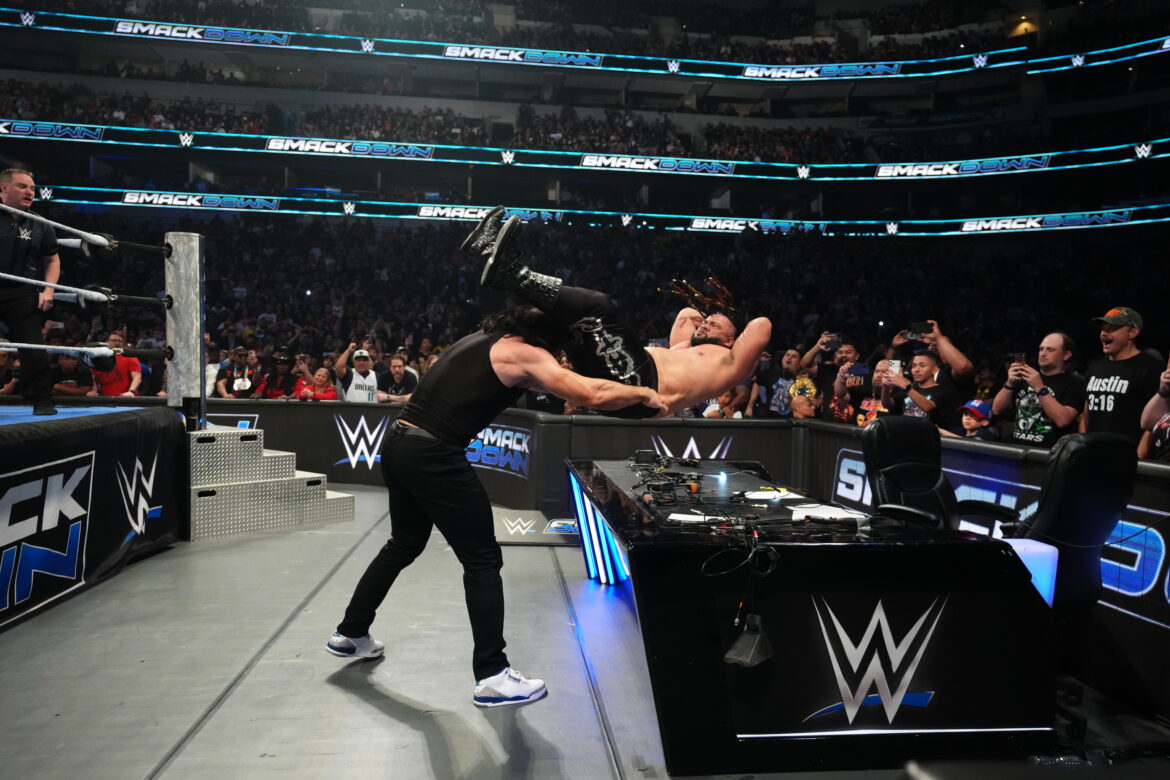
As the night drew to a close, the men’s main event picture became sharply defined through a high-stakes triple threat Elimination Chamber qualifier involving Sami Zayn, Jacob Fatu, and Cody Rhodes. The tension was palpable, amplified by the manipulative machinations of Drew McIntyre, who, in a pre-match segment, offered seemingly sincere words of encouragement to Sami Zayn. McIntyre, ever the calculating heel, professed his belief in Zayn’s potential to finally capture the world championship, a sentiment that, while outwardly supportive, was undoubtedly part of a deeper, more sinister game. Zayn, perpetually the underdog striving for that elusive main event breakthrough, desperately needed this victory. Jacob Fatu, the newest and most destructive addition to Solo Sikoa’s MFTs, brought an unmatched intensity and brutal efficiency to the contest, showcasing why he is a force to be reckoned with. The match itself was a chaotic, hard-hitting affair, with all three men leaving everything in the ring. The climax arrived when Drew McIntyre made his presence felt at ringside. In a shocking display of calculated aggression, he delivered a devastating Claymore to Jacob Fatu, preventing what appeared to be a sure victory for the newest Bloodline enforcer. McIntyre then continued his assault, putting Fatu through the announcer’s table before turning his attention to Cody Rhodes. Another Claymore dropped "The American Nightmare," and in a moment that epitomized his cunning, McIntyre physically dragged the prone Sami Zayn over Cody for a pinfall attempt. Astonishingly, Cody Rhodes kicked out, demonstrating his incredible resilience and unwavering spirit. The match continued, with Zayn, fueled by adrenaline and desperation, managing to hit McIntyre with a Helluva Kick. But before he could capitalize, Cody Rhodes, seizing the opportune moment, countered with a Cross Rhodes on Zayn, securing the pinfall and his spot in the Elimination Chamber. This finish masterfully served multiple ongoing storylines: McIntyre’s continued manipulation and pursuit of chaos, Zayn’s heartbreaking inability to seize the ultimate moment despite external aid, Fatu’s brutal introduction and the challenges of the MFTs, and Cody Rhodes’s unwavering path towards finishing his story. The heat generated throughout this main event encounter was immense, a testament to the compelling narratives converging on the Road to WrestleMania.
While the initial hour of SmackDown may have presented some perplexing creative choices regarding the Women’s Tag Team Championship and the United States Title’s standing, the broadcast undeniably found its stride in the latter two hours. The elevation of Trick Williams, the undeniable star power of Liv Morgan, and the intricate, high-stakes drama of the main event qualifier all contributed to a captivating evening. The blue brand successfully deepened the narrative threads leading into Elimination Chamber, setting the stage for an even more intense journey towards WrestleMania 42. The pursuit of destiny, both individual and collective, continues, and SmackDown delivered a potent reminder that every victory, every defeat, and every calculated move is a crucial brushstroke in the unfolding tapestry of professional wrestling’s grandest spectacle.