In the often theatrical world of professional wrestling, where the lines between performance and reality can blur for the sake of compelling storytelling, an unexpected moment unfolded recently at a smaller independent wrestling event, capturing the attention of the wrestling community and beyond. A video circulated online, seemingly depicting a wrestler, formerly a prominent figure in WWE, engaging in a physical altercation with a ringside spectator. The incident, which occurred at a Championship Wrestling event in Boca Raton, Florida, on a recent Sunday evening, raised immediate questions about the boundaries between performer and audience, and the protocols in place for managing interactions outside the predetermined narrative of a wrestling match.
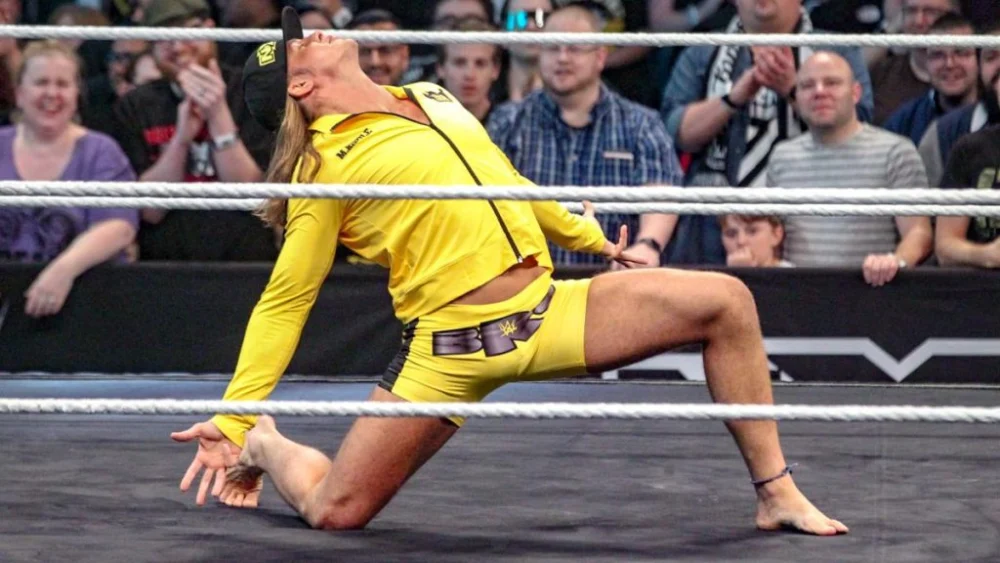
The footage in question, shared across social media platforms, shows Matt Riddle, a wrestler who enjoyed a significant run in WWE, interacting with a fan identified as James Michael Oja, Jr. Oja, who presents himself on his Instagram profile as a "bad-ass construction worker," has a history of publicly issuing online challenges to various professional wrestling personalities, including Riddle himself, as well as Brock Lesnar, CM Punk, and AJ Francis. This context is crucial, as it suggests a pre-existing dynamic, albeit an informal and likely unsolicited one, between Oja and the wrestling world he sought to engage with.
During a match between Riddle and Stallion Rogers, the in-ring action extended beyond the traditional confines of the squared circle, spilling out towards the ringside area. It was at this juncture that the cameras captured the interaction. Rogers moved towards the barricade directly in front of Oja, who was positioned in a front-row seat, his hands resting on the barrier. The video then shows Riddle approaching Oja, a smile visible on his face. After what appears to be a brief exchange of words, Riddle is seen extending his hand and pushing Oja in the face. Notably, Oja remains on his feet, his hands still gripping the barricade, suggesting the shove, while physical, did not result in him losing his balance or significantly disengaging from his position. This visual evidence forms the core of the discussion surrounding the incident.
To fully appreciate the context of Matt Riddle’s presence and his subsequent actions, it’s important to understand his journey into professional wrestling. Riddle’s athletic background is rooted in mixed martial arts. He gained considerable recognition as a competitor on Season 7 of The Ultimate Fighter, a reality television series that serves as a proving ground for aspiring MMA fighters. During his tenure in the Ultimate Fighting Championship (UFC), Riddle demonstrated considerable talent, securing seven victories. His performances were often lauded, earning him accolades such as "Fight of the Night" and "Submission of the Night" awards. However, his UFC career eventually came to an end following a positive drug test for marijuana, a substance that, at the time, carried significant implications within the organization.
Following his departure from the UFC, Matt Riddle transitioned his athletic prowess to the world of professional wrestling. He underwent training at the renowned Monster Factory, a wrestling school with a storied history of developing talent. His early career in the independent wrestling scene was met with significant acclaim. In 2016, he was recognized by the prestigious Wrestling Observer Newsletter, receiving awards for both Rookie of the Year and Most Improved, solidifying his status as a rapidly ascending talent with a bright future.
His burgeoning career led him to the global stage of WWE, where he officially signed in 2018. Within the WWE system, Riddle quickly made a name for himself, amassing a collection of championship accolades. He captured the NXT Tag Team Championship, showcasing his ability to perform effectively as part of a tag team. He also achieved success in singles competition, winning the prestigious United States Championship. Furthermore, he formed a highly popular and successful tag team with Randy Orton, known as "RK-Bro," and together they won the WWE Raw Tag Team Championship on two separate occasions. This period cemented Riddle as a key figure in WWE’s mid-card and tag team divisions.

However, Riddle’s tenure with WWE concluded in 2023. His release from the company was reportedly linked to an incident involving law enforcement at JFK International Airport. Following his departure from WWE, Riddle returned to the independent wrestling circuit, continuing to compete and engage with fans in various promotions. This return to the independent scene is where the recent incident occurred, placing him back in the spotlight, albeit for reasons that deviate from his in-ring performances.
The nature of professional wrestling itself is a complex tapestry woven with athleticism, entertainment, and carefully crafted narratives. Wrestlers often embody larger-than-life characters, engaging in feuds and rivalries that are designed to elicit strong emotional responses from the audience. This often involves a degree of theatricality, where the performers play a role, and the audience is expected to suspend their disbelief. However, the physical interaction captured in the video raises questions about where the performance ends and personal conduct begins, particularly when it involves direct engagement with individuals who are not part of the scripted storyline.
The role of fans in professional wrestling is undeniably significant. They are the lifeblood of the industry, their cheers and boos fueling the energy of the arena. Ringside seats, in particular, offer a unique and immersive experience, placing fans in close proximity to the action. While this proximity can enhance the spectacle, it also necessitates a degree of respect for boundaries, both from the performers and the audience. Wrestlers are expected to maintain a level of professionalism, even when playing a heel character, and fans are generally expected to refrain from actions that could disrupt the show or compromise the safety of the performers.
In this specific instance, the video suggests a brief, unsolicited physical interaction initiated by the wrestler. The fact that Oja had previously issued public challenges to wrestlers might suggest a desire for attention or interaction, but it does not inherently grant permission for physical contact. The wrestling environment, while designed for excitement, is not a free-for-all. The incident serves as a reminder of the delicate balance that must be maintained. Wrestlers are athletes and entertainers, but they are also individuals who deserve to be treated with respect and to have their personal space acknowledged.
The fallout from such incidents, even if seemingly minor, can have wider implications. For Matt Riddle, whose career has already seen its share of controversies, this event could potentially impact future booking opportunities or further shape public perception. For the independent wrestling promotion, it highlights the challenges of managing talent and ensuring that all participants, including fans, adhere to appropriate conduct. The digital age, with its ubiquitous recording devices and rapid dissemination of information, means that even isolated incidents can gain widespread attention, sparking debate and scrutiny.
The wrestling world is no stranger to moments where the lines between kayfabe (the portrayal of staged events as real) and reality blur. However, when physical altercations occur outside the established narrative and involve members of the audience, the situation shifts. It moves from a theatrical disagreement between characters to a real-world confrontation. The responsibility for de-escalating such situations typically falls on the performers and event staff, who are trained to handle disruptions while maintaining the integrity of the show.
Ultimately, the incident involving Matt Riddle and the ringside fan serves as a microcosm of the ongoing dialogue surrounding fan-wrestler interaction. It underscores the importance of mutual respect, the understanding of boundaries, and the recognition that while professional wrestling is a form of entertainment, it involves real people in a physical environment. As the industry continues to evolve, so too will the expectations and protocols governing these interactions, aiming to ensure that the spectacle remains exciting and engaging without compromising the safety and dignity of all involved. The video, while capturing a fleeting moment, has sparked a broader conversation about conduct, respect, and the enduring, yet sometimes complex, relationship between the performers and those who enthusiastically support them.