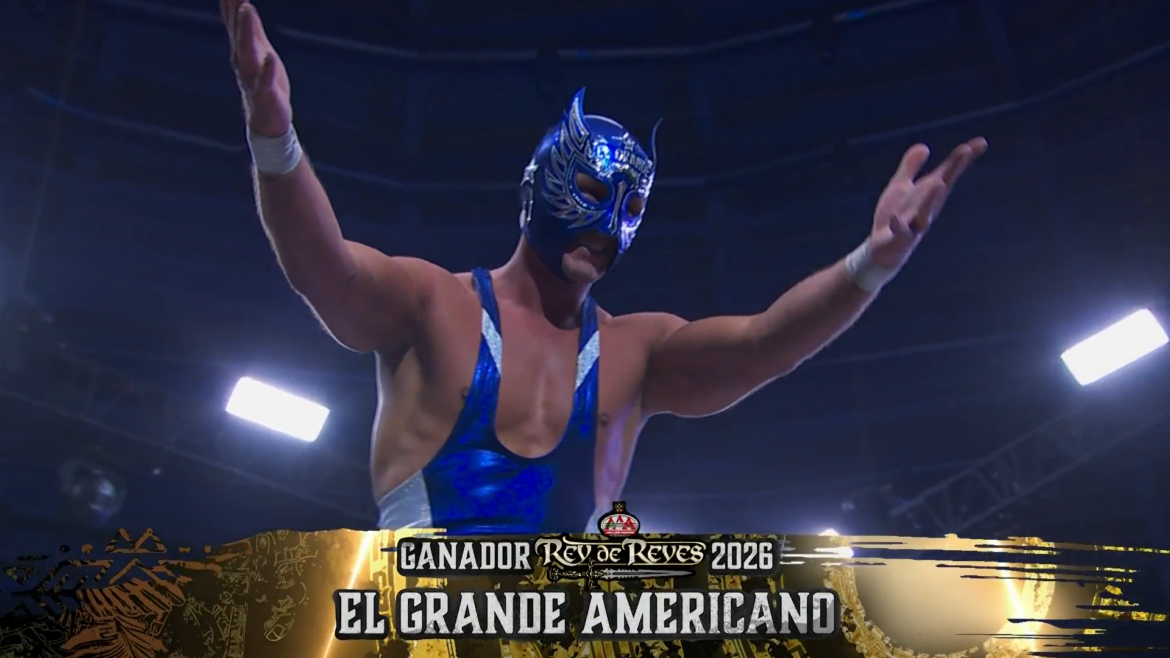
The air inside the arena on that fateful Saturday night, March 14, 2026, was thick with anticipation, a palpable blend of hope and fervent nationalism that only lucha libre in Mexico can conjure. As the final bell tolled, echoing the decisive three-count, a collective roar erupted, shaking the very foundations of the building. El Grande Americano, the enigmatic figure who had captured the hearts of a nation, stood victorious, the prestigious Rey de Reyes tournament trophy within his grasp. This was no mere victory; it was a profound declaration, a redemption arc brought to a thrilling crescendo, dedicated not just to personal glory, but to a beloved fallen comrade, Pimpinela Escarlata, and to the unwavering spirit of Mexico itself.
For generations, the Rey de Reyes tournament has stood as one of Lucha Libre AAA Worldwide’s most hallowed traditions, a grueling crucible designed to forge a true champion. More than just a silver platter or a ceremonial crown, the victor earns the sacred sword, a symbol steeped in legend and honor, to be presented in a subsequent AAA television broadcast. Crucially, this triumph also guarantees a future opportunity to challenge for the coveted AAA Mega Championship, the ultimate prize in the promotion. To win Rey de Reyes is to announce oneself as a legitimate main event player, a standard-bearer for the company, and a champion worthy of the people’s adulation. For El Grande Americano, known to many behind the mask as Ludwig Kaiser, this win transcended even these grand implications, imbued as it was with a deeply personal and nationalistic fervor.
The emotional core of El Grande Americano’s journey to this pinnacle moment lay in the tragic and cowardly actions of his doppelganger and arch-rival, Original Grande Americano (Chad Gable). In a shocking display of perfidy, OGA had brutally attacked the revered exótico icon, Pimpinela Escarlata. Pimpinela, a flamboyant and beloved figure whose career spanned decades, embodying the vibrant, gender-bending tradition of lucha libre, had dared to expose OGA’s deceit – his fraudulent claim to Mexican heritage. The assault left Pimpinela hospitalized, his vibrant presence temporarily dimmed. From his hospital bed, a solemn plea was issued, a final wish entrusted to El Grande Americano: win Rey de Reyes, not for himself alone, but in honor of Pimpinela and for the very soul of Mexico. This mandate transformed El Grande Americano from a mere competitor into a vessel for justice, a champion carrying the hopes of a wounded legend and an insulted nation.
The narrative surrounding El Grande Americano, a performer of European descent, embracing the mantle of a "Grande Americano" (Great American) for Mexico, was particularly poignant. Unlike OGA, who feigned a connection to Mexican culture for cynical gain, EGA’s journey had been one of genuine respect and assimilation, earning him the admiration of the aficionados. His dedication to Pimpinela and his earnest representation of Mexican pride resonated deeply, casting him as an authentic hero in stark contrast to OGA’s opportunistic charade. This Rey de Reyes final, therefore, became more than a wrestling match; it was a cultural referendum, a battle for the integrity of identity and the heart of lucha libre itself.
The stage for this monumental clash was a fatal four-way encounter, a chaotic and unpredictable format where alliances are fleeting and every man fights for himself. Arrayed against El Grande Americano were the aforementioned Original Grande Americano, the conniving and established heel Santos Escobar, and the legendary, unpredictable presence of La Parka. Each competitor brought their own unique motivations and rivalries into the squared circle, ensuring a volatile mix. OGA sought to cement his fabricated persona and continue his reign of terror. Santos Escobar, always the opportunist, aimed to seize the spotlight and add another feather to his cap, regardless of the cost. La Parka, the veteran maestro of mayhem, was simply there to wreak havoc and potentially steal the win, as is his enigmatic way.
From the opening bell, the match was a whirlwind of motion and high-stakes maneuvers. The crowd’s allegiance was undeniable, erupting whenever El Grande Americano gained an advantage, and showering OGA with jeers at every villainous turn. The early exchanges were a testament to the diverse styles in the ring: La Parka’s signature antics mixed with surprising bursts of athleticism, Santos Escobar’s calculating strikes and submissions, and the raw power exchanges between the two "Americanos." It quickly became clear that OGA was intent on denying the people what they wanted, constantly inserting himself whenever El Grande Americano and his imposter were on the verge of a decisive confrontation, prolonging the inevitable and fueling the crowd’s frustration.
A pivotal moment of the contest arrived with a dramatic escalation of the personal rivalry between the two men claiming the "Grande Americano" moniker. Both wrestlers, known for their innovative and often illicit tactics, revealed that they had loaded their masks with steel plates, a clear sign of their intent to inflict maximum damage. The target, in a bizarre twist, appeared to be La Parka. As EGA and OGA charged from opposite ends of the ring, poised to deliver a devastating double headbutt to the iconic skeleton-clad luchador, La Parka, with his characteristic agility and cunning, dipped low at the last possible second. The result was a thunderous, sickening collision as the two Americanos crashed head-to-head, a moment of poetic justice that saw their own underhanded tactics backfire spectacularly.
The impact momentarily incapacitated both men, but the animosity was too deep to be contained within the ring ropes. Recovering first, the two bitter rivals spilled out of the ring and engaged in a furious brawl that traversed the arena floor, weaving through the stunned spectators and disappearing backstage. This extended, personal skirmish allowed the other competitors to take center stage, but the crowd’s attention remained fixated on the missing Americanos. Just as the audience wondered if the personal vendetta would cost El Grande Americano his shot at glory, he reappeared, dragging himself back to the ring, a renewed fire in his eyes. He then pointed triumphantly to the upper deck, where, much to the delight of the Mexican faithful, Original Grande Americano was seen handcuffed to the railing, held captive by El Grande Americano’s trusted associates, Bravo and Rayo. This clever maneuver was a direct and satisfying callback to an earlier qualifier match where OGA had employed the very same tactic, handcuffing EGA to steal his rightful spot in the tournament. The scales of justice, it seemed, were beginning to balance.
With OGA neutralized, the focus shifted to the remaining combatants. Santos Escobar, ever the calculating villain, had seized control of La Parka, ruthlessly employing a steel chair to brutalize the veteran. His actions were a testament to his "win at all costs" mentality, but they also highlighted his ongoing, intensely personal feud with El Hijo de Dr. Wagner Jr. For weeks leading up to Rey de Reyes, Santos had tormented Wagner through various nefarious means, including parking lot ambushes and, significantly, preventing Wagner from winning his own Rey de Reyes qualifier match. The bad blood was undeniable, and the seeds of retribution had been sown.
As Santos prepared to deliver another crushing chair shot to La Parka, a figure emerged from the backstage area, storming the ring with a furious intensity. It was El Hijo de Dr. Wagner Jr., his presence igniting the crowd once more. With a swift, decisive motion, Wagner snatched the steel chair away from Santos Escobar, thwarting his villainous attack and delivering a potent dose of payback. The look of disbelief and rage on Santos’s face was priceless, a momentary victory for justice within the chaos. The disruption proved costly for Escobar; reeling from the thwarted attack and the intervention, he stumbled backward, disoriented.
This disorientation was all La Parka needed. Seizing the opportunity, the legendary luchador executed a perfectly timed rolling cutter, sending Santos Escobar crashing to the canvas. The momentum had shifted, and the arena held its breath, sensing the climax approaching. It was at this precise moment that El Grande Americano, who had strategically re-entered the ring, saw his opening. With a burst of adrenaline and the weight of Pimpinela’s wish on his shoulders, he drove forward. Utilizing the very same loaded mask that had caused the earlier collision, he delivered a devastating, skull-rattling headbutt to a dazed La Parka. Without hesitation, and with the crowd’s energy propelling him, he immediately pivoted, delivering a second, equally brutal loaded headbutt to the reeling Santos Escobar.
The impact was definitive. Santos collapsed, unconscious, leaving him vulnerable for the pinfall. The referee’s hand slapped the canvas once… twice… and then, with a final, resounding thwack, three times. The bell shrieked, signaling the end of the war. El Grande Americano had done it. He had conquered the Rey de Reyes tournament. The arena exploded in a symphony of cheers, chants, and thunderous applause. It was a visceral release of emotion, a shared moment of triumph for every fan who had invested in his journey, for every supporter of Pimpinela Escarlata, and for every heart beating with Mexican pride.
As the referee raised El Grande Americano’s arm in victory, the masked warrior stood tall, his chest heaving, his gaze scanning the adoring crowd. He was no longer just a contender; he was a champion, a symbol, a folk hero reborn. The weight of his mission, the promise to Pimpinela and to Mexico, had been fulfilled. The sacred sword, a tangible representation of his triumph, awaited him, but the true prize was the affirmation of his spirit and the undeniable connection he had forged with the aficionados. Beyond the immediate glory, the victory secured him a guaranteed future shot at the coveted AAA Mega Championship, placing him firmly at the apex of the promotion’s hierarchy and signaling a new era for the company.
Yet, as the euphoria of victory settled, the lingering shadows of unfinished business loomed large. The Rey de Reyes final, while a definitive chapter, was merely a continuation of deeply personal sagas. Original Grande Americano, now humiliated and handcuffed, would undoubtedly be seeking furious retribution against El Grande Americano and his associates. The rivalry, steeped in issues of authenticity and stolen identity, was far from concluded. Similarly, Santos Escobar, a man who rarely forgets a slight, would be plotting his revenge against El Hijo de Dr. Wagner Jr. for his costly interference, and against El Grande Americano for snatching victory from his grasp. La Parka, ever the wild card, would continue to weave his unpredictable path, a constant threat to any champion.
El Grande Americano’s journey to the Rey de Reyes crown was a testament to the enduring power of lucha libre storytelling. It was a narrative rich with betrayal, courage, loyalty, and the eternal struggle between authenticity and deception. His victory was more than just a notch in his belt; it was a powerful affirmation of the values he represented. In a world often cynical, El Grande Americano emerged as a beacon of hope, a champion who fought not just for himself, but for a greater cause, carrying the heart of a fallen exótico and the soul of a proud nation into battle. As the echoes of that unforgettable night continue to reverberate, one thing is clear: El Grande Americano has ascended, solidifying his place as a true hero, and setting the stage for even grander sagas in the vibrant tapestry of Lucha Libre AAA Worldwide.