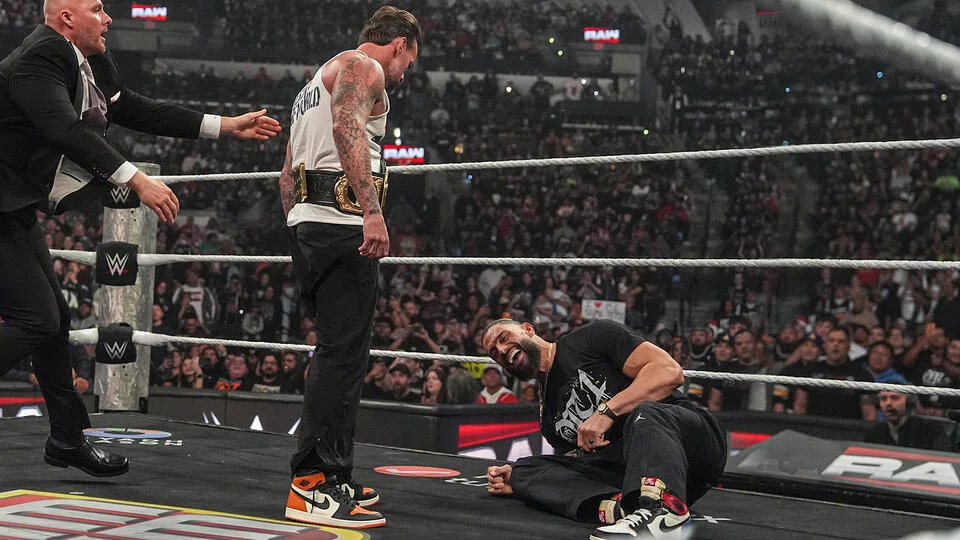
The recent edition of Monday Night Raw, specifically the broadcast on March 16, 2026, served as more than just another stop on the road to WrestleMania; it was a psychological battleground where the Tribal Chief, Roman Reigns, delivered a calculated and devastating blow to the perceived vulnerabilities of CM Punk. This wasn’t merely about wins and losses in the squared circle, but a deeply personal war for supremacy, legacy, and perhaps, the very essence of what it means to be a top-tier performer in the demanding world of professional wrestling. The night’s unfolding drama saw Reigns meticulously dismantle Punk’s self-proclaimed status, culminating in an unsparing verbal assault that aimed directly at Punk’s age and, by extension, his wrestling mortality.
From the outset of this intense rivalry, the narrative has been steeped in layers of historical animosity and conflicting philosophies. CM Punk, a figure synonymous with rebellion and a fierce independence, returned to WWE after a long hiatus, immediately reasserting his claim as "The Best in the World." Roman Reigns, meanwhile, has transformed into an unparalleled antagonist, the "Tribal Chief" whose dominant reign as Undisputed WWE Universal Champion has solidified his place at the apex of the industry. Their collision was inevitable, a clash of titans whose paths, once seemingly divergent, converged for what promised to be an epic showdown. Yet, this recent encounter on Raw shifted the focus from physical confrontation to a deeply personal and strategic war of words, with Reigns demonstrating a chilling aptitude for psychological warfare.
Earlier in the evening, prior to their climactic confrontation, Reigns had already showcased his evolving mastery of the mic, turning a persistent criticism into an unexpected badge of honor. For years, detractors, including Punk himself, have often lambasted Reigns for his reduced schedule, branding him a "part-timer" who doesn’t bear the full brunt of the company’s grueling travel demands. However, on this night, Reigns masterfully flipped the script. He acknowledged the "part-timer" label head-on, not as a weakness to be defended, but as a deliberate choice that allowed him to embrace a more profound commitment: that of a devoted family man. Reigns powerfully articulated that his schedule, far from being a sign of disinterest, enabled him to be a "full-time father and partner," drawing a poignant connection to the time his own father and uncles spent with their families during their wrestling careers. This particular declaration was more than just a clever retort; it was a strategic maneuver that disarmed Punk’s established line of attack. How does one effectively criticize a man for prioritizing his family? It positioned Reigns not just as a champion, but as a figure embodying aspirational values, making any counter-argument from Punk seem petty or insensitive. It was a deft move that simultaneously strengthened Reigns’ character and subtly undermined Punk’s moral high ground.
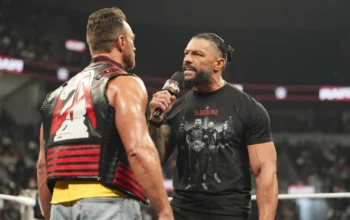
However, the true masterstroke, the moment that truly defined the Raw broadcast, occurred during the main event segment. The atmosphere was electric, thick with anticipation as the two adversaries stood face-to-face. Up to this point in their feud, there had been instances where Punk’s sharp wit and unfiltered remarks seemed to penetrate Reigns’ typically unshakeable composure. There were moments when Reigns, known for his stoicism, would betray a flicker of genuine disdain or frustration, suggesting Punk possessed a unique ability to get under his skin. This time, Reigns was determined to reverse that dynamic. He needed a retort that would not only silence Punk but also inflict a deep, lasting psychological wound. And he found it in one simple, devastating word: "old."
The impact of Reigns’ assertion that Punk was "old" reverberated through the arena and beyond, striking a nerve that ran far deeper than a mere ageist taunt. It was a direct assault on Punk’s identity, his capabilities, and perhaps his greatest fear. For a man who has built his entire persona around being "The Best in the World," a champion of defiance and physical prowess, the suggestion of age-related decline is an existential threat. This insult wasn’t just about the number of years Punk had lived, but rather the cumulative "mileage" on his body, a concept intimately understood by anyone who follows professional wrestling. The physical toll of decades in the ring, the countless bumps, the injuries – all of it contributes to an athlete’s wear and tear, and for Punk, this has been particularly pronounced in recent years.
Consider Punk’s recent history: a series of significant injuries that have punctuated his return to the wrestling landscape. These aren’t minor setbacks; they’ve been substantial, requiring lengthy periods of recovery and casting a shadow over his longevity. Each injury serves as a stark reminder of the brutal reality of his chosen profession and the finite nature of an athlete’s prime. Reigns’ barb, therefore, wasn’t just an observation; it was a weaponized truth, designed to exploit Punk’s deepest insecurities about his physical capacity to maintain his elite status. It subtly questioned whether the "Best in the World" could still keep pace with the evolving demands of the modern wrestling landscape, or if his body was beginning to betray his indomitable spirit.
The psychological weight of Reigns’ words is further amplified when viewed through the lens of Punk’s contemporaries. The recent retirement of AJ Styles, a peer with whom Punk has shared a similar trajectory and era, served as a poignant mirror. Styles, renowned for his incredible athleticism and seemingly ageless performances, made the difficult decision to step away, citing the increasing physical demands and the desire to spend more time with his family. Similarly, John Cena, another iconic figure from Punk’s generation, has transitioned into a more sporadic role, prioritizing Hollywood endeavors over the rigorous WWE schedule. These departures and transitions, occurring within Punk’s immediate professional sphere, naturally prompt introspection. If performers of Styles’ and Cena’s caliber are acknowledging the twilight of their full-time careers, what does that imply for Punk, who is of a similar vintage and has endured even more turbulent physical journeys? Reigns’ "old" comment thus tapped into a very real, very current contemplation for Punk: the approaching eventuality of his own professional sunset.
Furthermore, Reigns’ observation cleverly played into the current in-ring presentation of CM Punk. While still possessing an undeniable charisma and storytelling ability, Punk’s matches in this latest run have undeniably showcased a more deliberate, methodical pace. They are characterized by a palpable struggle, an evident exertion that suggests a body working harder to achieve the same results it once did with apparent ease. Each movement, each power maneuver, appears to demand a greater physical toll. This isn’t necessarily a criticism of his current style, which can convey a compelling narrative of resilience and veteran cunning, but it does lend credence to Reigns’ cutting remarks. Punk is, perhaps unwittingly, telling a story of a competitor battling against the relentless march of time, striving to overcome the physical limitations that inevitably creep in with age and injury. Reigns, on the other hand, consistently presents himself as a man still ascending, still perfecting his craft, a dominant force whose physical capabilities appear to be at their absolute peak, showing no signs of slowing down. The contrast between these two narratives—one of a man battling the inevitable, the other of a man only growing stronger—is stark and provides fertile ground for their psychological warfare.
Reigns’ ability to pivot from defending his "part-timer" status to attacking Punk’s age demonstrates a calculated evolution in his character. The "Tribal Chief" is no longer just a dominant force in the ring; he is a master manipulator, a strategic orator who understands the nuances of public perception and individual vulnerability. This wasn’t the Roman Reigns who, in earlier encounters with Punk, might have allowed his emotions to get the better of him, revealing a flash of anger or frustration. This was a composed, analytical Reigns, deploying his words with surgical precision, intent on dismantling his opponent’s psyche before ever stepping between the ropes for a physical contest. His comment about Punk’s age was not an outburst; it was a well-timed, devastating blow designed to sow seeds of doubt and self-reflection in the mind of a competitor whose greatest strength has always been his unshakeable self-belief.
The broader implications of this exchange extend beyond the immediate feud between Reigns and Punk. It highlights a critical aspect of modern professional wrestling: the increasing importance of narrative depth and character psychology. While athletic prowess and spectacular maneuvers remain vital, the ability to craft compelling stories, to tap into universal themes of ambition, legacy, and mortality, elevates the sport to an art form. Reigns’ recent performance on Raw was a masterclass in this regard, demonstrating how a well-placed promo can be as impactful, if not more so, than a championship match. It also sets a fascinating precedent for how veteran performers, like Punk, might navigate the latter stages of their careers, forced to confront the realities of their physical limitations while striving to maintain their iconic status.
This particular Raw episode, while culminating in the explosive Reigns-Punk segment, was lauded for its overall impactful presentation. It reportedly opened strong, setting a tone of high stakes, and maintained that momentum throughout, avoiding the "filler" segments that can sometimes plague weekly wrestling programming. While the long-term storytelling involving Oba Femi and the potential trajectory of Brock Lesnar towards WrestleMania was certainly bubbling beneath the surface, it was the psychological chess match between Reigns and Punk that commanded the spotlight. The opening and closing segments, particularly the latter, served as powerful bookends, framing a night where words were wielded with the force of a thousand powerbombs.
As the wrestling world continues its march towards the grandeur of WrestleMania, the seeds planted on this March 16th edition of Raw will undoubtedly blossom into a captivating and deeply personal rivalry. Roman Reigns has proven his capacity not only to physically dominate but to intellectually and psychologically outmaneuver his opponents. By attacking CM Punk’s perceived weakness—his age and the specter of his wrestling mortality—Reigns has opened a new, intensely personal front in their war. The question now looms large: Can CM Punk, "The Best in the World," overcome not just the formidable physical challenge of the Tribal Chief, but also the insidious doubts planted by Reigns’ strategic assault on his very essence as a performer? The answer will define legacies and determine who truly stands as the undisputed force in professional wrestling. The battlefield is set, and the weapons are not just fists and feet, but words, perception, and the relentless ticking clock of time itself.