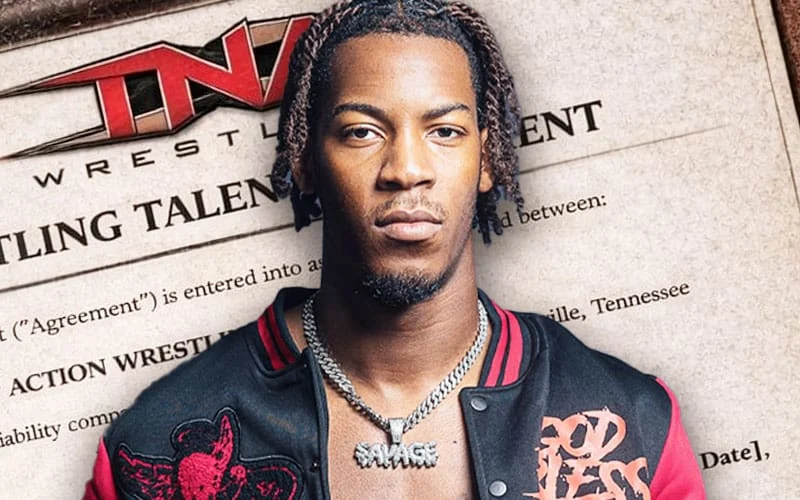
The professional wrestling landscape has always been defined by its ability to create moments of genuine emotional resonance, often blending the lines between a scripted narrative and the very real professional milestones of the athletes involved. At the recent Sacrifice event held on March 27, 2026, TNA Wrestling attempted to capture one of these lightning-in-a-bottle moments by officially welcoming Ricky Sosa into the fold. The scene was designed to be a quintessential "arrival" segment, featuring the company’s President, Carlos Silva, and the legendary Tommy Dreamer, a man whose name is synonymous with the grind of the independent scene and the heart of the industry. Standing in the center of the ring, Sosa put pen to paper, signaling a new chapter in his career and a significant recruitment win for a TNA brand that has been aggressively seeking to diversify its roster and tap into international markets. However, the celebratory atmosphere of the pay-per-view was short-lived, as the signing quickly ignited a firestorm of controversy originating from the very training grounds where Sosa honed his craft.
In the modern era of professional wrestling, the journey from a local independent promotion to a televised global stage is often viewed as the ultimate success story. For TNA, the addition of Sosa was not just a roster expansion but a strategic move to show that they remain a premier destination for the world’s most promising talent. To underscore their commitment to their newest signee, the promotion immediately launched a line of official merchandise, a move that typically signals a high level of confidence in a wrestler’s marketability and future positioning on the card. Yet, as the ink was still drying on the contract and the promotional graphics were being circulated across social media, a dissenting voice emerged from France that challenged the ethics of the entire transaction. The leadership at KHAO Wrestling, the French promotion where Sosa had previously been a foundational figure, did not take the news of his departure as a point of pride. Instead, the owner of the organization launched a scathing public critique of TNA’s business practices, accusing the American promotion of predatory behavior toward the independent circuit.
This conflict highlights a long-standing tension within the professional wrestling industry regarding the pipeline of talent. For decades, smaller promotions have served as the unofficial developmental territories for major corporations, often investing years of time, money, and creative resources into building a performer’s profile only to see them depart the moment a larger platform comes calling. The outcry from KHAO Wrestling centered on the idea that major entities like TNA take advantage of the inherent instability of the independent scene. The French promoter’s argument suggests that these larger companies "poach" talent by offering the allure of superstardom—specifically referencing the aspiration of eventually reaching the heights of WWE—while providing no formal compensation or professional courtesy to the promotions that actually did the heavy lifting of training and polishing the talent. This sentiment reflects a growing frustration among international promoters who feel that their contributions to the global wrestling ecosystem are being ignored by the industry’s power players.
The rhetoric used by the KHAO Wrestling ownership was particularly sharp, painting a picture of an industry where the "fragility" of the indie scene is exploited for the benefit of those at the top. The accusation is that TNA and similar organizations sell a dream to young performers, one that often ignores the reality of the sacrifices made by the local scenes that sustained those performers during their formative years. This perspective posits that without some form of reciprocal relationship or talent-sharing agreement, the independent scene will continue to struggle as its most profitable and recognizable stars are plucked away without any return on investment for the original promoters. While this is a common occurrence in the United States, where the "feeder system" is more established, the blow seems to have landed harder in France, a region that is still working to solidify its standing in the global wrestling hierarchy.
Beyond the systemic criticisms of the wrestling industry’s talent acquisition model, the situation took a remarkably personal turn. The KHAO promoter did not limit his grievances to TNA as an organization; he also directed his ire toward Ricky Sosa himself. In a series of public statements, he attempted to devalue Sosa’s individual contributions to his own success, claiming that the wrestler’s current trajectory was largely a result of the creative direction provided by KHAO. The promoter went as far as to suggest that a simple change in entrance music, orchestrated by the promotion, was the catalyst that saved Sosa from being an obscure "jobber" in the local Nanterre circuit. This type of public disparagement is rare in a professional context, as it directly attacks the performer’s credibility and suggests that they lack the innate talent to succeed without specific managerial intervention. By framing Sosa’s rise as a byproduct of KHAO’s ingenuity rather than Sosa’s own hard work, the promoter added a layer of personal betrayal to the professional dispute.
This development has cast a shadow over what should have been the most significant week of Ricky Sosa’s professional life. Instead of focusing entirely on his upcoming matches and his integration into the TNA roster, Sosa finds himself at the center of a debate regarding loyalty, professional ethics, and the value of independent wrestling. For TNA, the situation presents a public relations challenge. While they have successfully secured a talented young athlete, they are now being branded as "exploiters" by a vocal segment of the European wrestling community. This is particularly problematic for Carlos Silva and the TNA executive team, who have spent a considerable amount of energy trying to position the company as a "talent-friendly" alternative to the rigid structures of larger competitors. If the perception takes hold that TNA is indifferent to the health of the global independent scene, it could hamper their ability to form partnerships and scout talent in other international markets in the future.
The mention of Nanterre in the promoter’s rant is a specific geographical marker that underscores the grassroots nature of the French wrestling scene. In these localized environments, every wrestler is a vital part of the show’s economy, and the loss of a top star can have a measurable impact on ticket sales and fan engagement. When a promoter feels that their investment has been "stolen," the reaction is often visceral. However, from the perspective of a wrestler like Sosa, the opportunity to sign with a promotion like TNA is often the culmination of a lifelong goal. In the competitive world of professional wrestling, windows of opportunity are notoriously small and can close without warning due to injury or shifts in management. For most performers, the chance to move from the French independent circuit to a televised American promotion is not something that can be turned down out of a sense of regional loyalty.
The debate sparked by this incident also touches on the lack of a standardized transfer system in professional wrestling. Unlike professional soccer, where smaller clubs receive "transfer fees" when their players move to larger organizations, wrestling operates on a "free agent" model that often leaves independent promoters with nothing but a hole in their creative plans. While some major companies have attempted to mitigate this by forming official developmental partnerships, many independent promoters feel these agreements are one-sided and primarily benefit the larger entity. The KHAO Wrestling owner’s assertion that this cycle "can’t go on any longer" suggests a desire for a fundamental shift in how talent transitions are handled, though the path to such a change remains unclear in a fragmented industry.
Despite the noise coming from France, TNA appears to be moving forward with their plans for Sosa with full steam. The involvement of Tommy Dreamer in the signing ceremony was a calculated choice, likely intended to lend the moment an air of legitimacy and "old school" respect. Dreamer, who has worked in nearly every facet of the business from the original ECW to the modern era, is often seen as a mentor figure for younger talent. His presence was a signal to the audience that Sosa has the endorsement of one of the industry’s most respected veterans. By positioning Sosa alongside Dreamer and Silva, TNA was making a statement that he is not just another name on the roster, but a cornerstone of their future strategy. The immediate release of merchandise further cements this, as it forces the audience to view Sosa as a "star" from day one.
As the situation continues to unfold, the wrestling world is left to ponder the complexities of the modern talent pipeline. Is TNA simply following the established rules of a cutthroat business, or is there a moral obligation to provide "consideration" to the smaller companies that act as the industry’s lifeblood? For Ricky Sosa, the challenge will be to separate himself from the controversy and prove his worth in the ring. The "jobber in Nanterre" comment is a heavy label to carry, and he will undoubtedly feel the pressure to demonstrate that his success is a result of his own skill and charisma, rather than just a lucky change in presentation or music. In the end, the ring is the only place where these questions can truly be answered.
The fallout from the Sacrifice signing serves as a reminder that the professional wrestling world is smaller and more interconnected than ever before. A tweet from a promoter in France can instantly become a headline in the United States, affecting the narrative of a major pay-per-view event. As TNA continues its journey under the leadership of Carlos Silva, they will likely face more of these growing pains. The company’s ambition to be a global force requires them to navigate the delicate politics of international wrestling, where the line between "scouting" and "poaching" is often a matter of perspective. For now, Ricky Sosa remains a TNA wrestler, but the circumstances of his arrival have ensured that his debut will be remembered as much for the bridge he burned as for the one he crossed. The industry will be watching closely to see if this controversy fades into the background or if it marks the beginning of a more significant conversation about the rights and responsibilities of promotions at every level of the game.