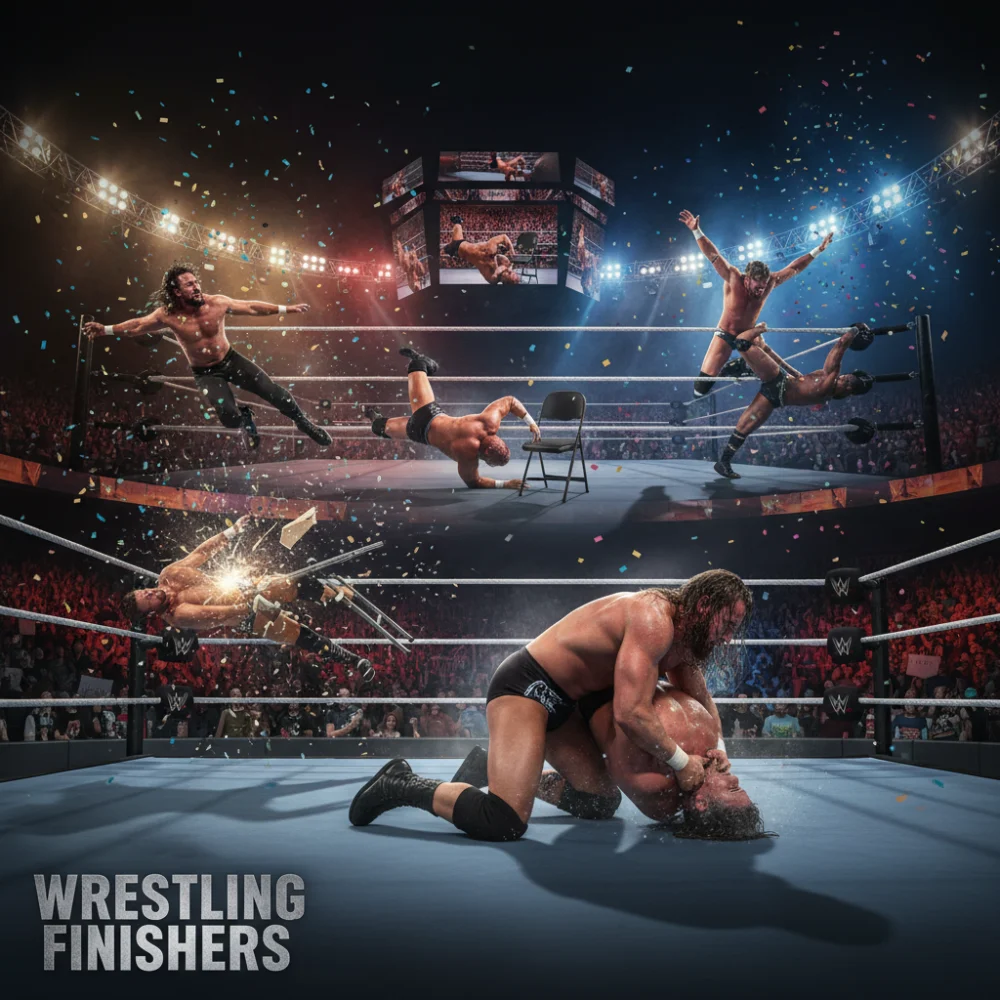
In the theatrical world of professional wrestling, the narrative arc of a match is paramount. While the opening exchanges establish dominance and the middle portion tells the story of struggle and resilience, the conclusion is defined by the finisher. A wrestling finisher is not merely a move; it is the punctuation mark at the end of a sentence, the crescendo of a violent symphony. It represents the ultimate weapon in a performer’s arsenal, designed to incapacitate an opponent and secure the three-count or submission. Understanding the finisher is essential to understanding the psychology of the squared circle.
The psychology behind a finishing maneuver relies heavily on Pavlovian conditioning. Over weeks, months, or even years, audiences are trained to recognize a specific sequence of movements that signals the end of a contest. When a wrestler executes their signature setup—be it Shawn Michaels tuning up the band or The Rock removing his elbow pad—the crowd reacts instinctively. This reaction, known in the industry as a ‘pop,’ is the release of tension built throughout the match. If a finisher is established correctly, the mere attempt to perform it generates suspense, while its successful execution brings catharsis.
The Evolution of the Finisher
The concept of the finisher has evolved drastically since the carnival days of catch-as-catch-can wrestling. In the early 20th century, matches were often legitimate contests of attrition, ending with basic holds like a half-nelson or a bear hug. As wrestling transitioned into a performance art, the need for dramatic, visually distinct endings became apparent. By the 1980s, the era of Hulk Hogan, the finisher became a branding tool. The Leg Drop was simple, but combined with Hogan’s charisma, it was lethal. Today, finishers have become increasingly athletic and complex, often drawing from gymnastics and martial arts.
One of the most critical aspects of a successful finisher is credibility. In wrestling terminology, a move must be ‘protected.’ This means that when the move is hit, the match should end. If opponents constantly kick out of a wrestler’s finishing move, the move loses its value and the audience stops believing in its power. Legends like The Undertaker protected the Tombstone Piledriver for decades; very few wrestlers were ever allowed to survive it. This protection elevates the stakes; when someone finally does kick out, it becomes a shocking, memorable moment rather than a routine occurrence.
Categories of Devastation
Finishers generally fall into four primary categories, each serving a different style of wrestler. The first is the Impact Finisher. These are slams and throws that rely on the illusion of crushing force. The Powerbomb, the Chokeslam, and the DDT fall into this category. They are visually loud and look painful, making them perfect for larger, powerhouse wrestlers who need to demonstrate physical superiority. The physics of these moves usually involve driving the opponent’s back, head, or neck into the canvas with high velocity.
The second category is the Strike Finisher. Popularized in the modern era but rooted in martial arts, these moves involve a knockout blow. The most famous example is undoubtedly Shawn Michaels’ Sweet Chin Music (Superkick). Strike finishers can be executed suddenly, allowing for dramatic reversals and surprise endings. In recent years, moves like the V-Trigger and the Claymore Kick have kept this tradition alive, offering a sudden, violent conclusion that mimics the knockout blow of a boxing or MMA match.
The third category is the Submission Finisher. These are holds designed to force a verbal or physical tap-out. Submission finishers are excellent for storytelling, as they allow for a prolonged period of drama where the hero fights against the pain, debating whether to quit. Iconic holds like Bret Hart’s Sharpshooter, Ric Flair’s Figure Four Leglock, and Kurt Angle’s Ankle Lock are steeped in technical wrestling tradition. They establish the user as a master tactician who can dismantle an opponent without needing to pin their shoulders to the mat.
The final major category is the Aerial Finisher. Reserved for the high-flyers and risk-takers, these moves involve leaping from the top turnbuckle. The risk-reward factor is built into the narrative; if the wrestler misses, they crash and burn, usually costing them the match. ‘Macho Man’ Randy Savage’s Diving Elbow Drop and Jeff Hardy’s Swanton Bomb are prime examples. These moves provide the spectacle that modern audiences crave, turning the wrestler into a human projectile.
The Element of Surprise: The ‘Out of Nowhere’ Factor
Some of the most popular finishers in history share a common trait: they can be applied ‘out of nowhere.’ The Diamond Cutter, popularized by Diamond Dallas Page, and its spiritual successor, Randy Orton’s RKO, are masters of this philosophy. Because these moves do not require a complex setup, they can be used to counter an opponent’s offense instantly. This keeps the audience on the edge of their seat, knowing that the match could end at any split second, regardless of who is currently dominating the action.
Conversely, some finishers rely entirely on theatricality and anticipation. The Stone Cold Stunner is effective not just because of the jaw-breaker motion, but because of the kick to the gut that precedes it. That split-second pause allows the crowd to rise to their feet before the impact. Similarly, The Rock’s People’s Elbow is arguably the most theatrical move in history, involving removing an elbow pad and running the ropes, yet it was devastatingly effective in the context of the Attitude Era because it engaged the crowd’s emotion.
In the modern era, particularly in promotions like AEW and New Japan Pro-Wrestling, the concept of the finisher has shifted toward the ‘Super Finisher.’ This is a tier of move above a standard signature. For example, Kenny Omega’s One-Winged Angel is arguably the most protected move in modern wrestling. As of this writing, almost no one kicks out of it. This extreme level of protection builds a mythos around the wrestler, making the move itself a character in the story. When the move is teased, the panic in the opponent’s selling tells the audience that this is the end of the line.