The spectacle of professional wrestling, a dynamic fusion of athleticism, drama, and combat sports, continually pushes the boundaries of human performance. Yet, beneath the dazzling lights and roar of the crowd lies a stark reality: the immense physical toll exacted upon its practitioners. This enduring truth was brought into sharp focus once again following a harrowing sequence at AEW’s Worlds End pay-per-view on December 27, an incident that prompted a legendary figure, William Regal, to issue a somber, unequivocal message to the current generation of in-ring competitors.
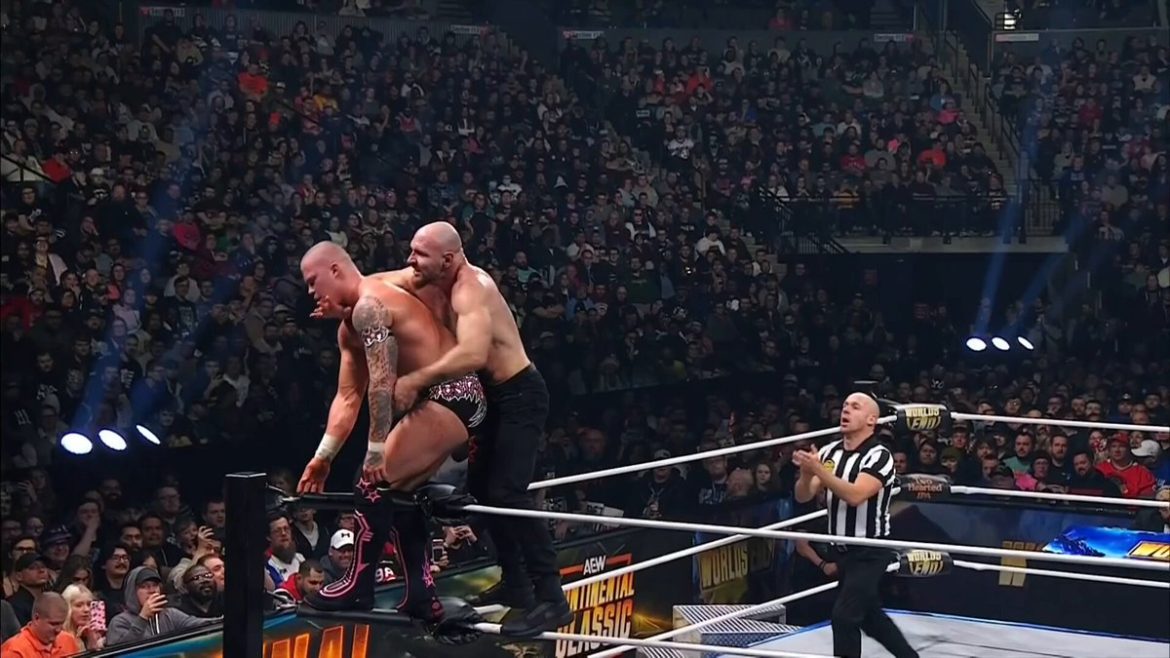
The moment in question transpired during one of the highly anticipated Continental Classic semi-final bouts, pitting the relentless Jon Moxley against the formidable Kyle Fletcher. This tournament, designed to crown AEW’s inaugural Continental Champion, had already delivered a series of grueling encounters, showcasing the diverse talents across the roster. Moxley, a seasoned veteran known for his hard-hitting style, and Fletcher, a rising Australian star with a blend of agility and power, were locked in a fiercely contested battle. Roughly midway through their contest, a top-rope suplex executed by Moxley saw Fletcher take an incredibly dangerous bump, landing directly on the crown of his head, causing his neck to bend at an alarming and deeply unnatural angle.
The immediate visual was enough to send a collective shiver through the audience, both live and watching from home. Ringside, even the seasoned analyst Bryan Danielson, himself no stranger to serious neck and head trauma, reacted with palpable concern, a silent testament to the severity of the impact. For a brief, terrifying instant, time seemed to stand still, the inherent risks of the profession laid bare for all to witness. Remarkably, following the jarring impact, the match continued its course, culminating in an unexpected and thrilling conclusion that saw Moxley advance to the tournament final. Post-event updates from various wrestling media outlets swiftly indicated that Fletcher, despite the terrifying landing, appeared to have escaped any immediate, severe physical repercussions. His subsequent appearance in a promotional segment, where he passionately articulated his focus on future endeavors within the Don Callis Family storyline, offered no hint of a need for a hiatus, seemingly confirming his immediate well-being.
However, the apparent lack of immediate injury did little to alleviate the underlying disquiet within the wrestling community, particularly among those who have dedicated their lives to understanding and mitigating the inherent dangers of the squared circle. It was against this backdrop that William Regal, a man whose career has spanned decades and who has navigated the very precipice of physical breakdown, felt compelled to speak out. Without explicitly naming Kyle Fletcher or referencing the Worlds End incident directly, Regal took to social media to share a potent warning, accompanying his words with stark X-ray images of his own neck, a testament to years of in-ring combat and the subsequent medical interventions required to manage the damage.
Regal’s message was not merely a cautionary tale but a deeply personal and impassioned plea. He revealed the extent of his own physical sacrifices, detailing two separate occasions where he fractured his neck – once in the ring in September 1993, and again in a car accident in 1997. In a shocking confession, he admitted to deliberately concealing these severe injuries from management and medical personnel, continuing to compete despite the profound risks. This decision, driven by the unwavering commitment of a professional wrestler to their craft and livelihood, illustrates the immense pressure performers face. He reflected on the traditional training methods he received, emphasizing the critical skill of "bridging" – a technique designed to distribute impact away from the head and neck during falls, a fundamental lesson he now observes is largely absent from contemporary wrestling education.
The veteran grappler lamented that this vital defensive technique, once a cornerstone of professional training, has become a rarity, perhaps known to only a tiny fraction of today’s talent. He spoke of the various "tricks" he learned and employed to continue his career, maneuvers born out of necessity to protect himself while injured, which, he noted, are no longer passed down or understood by those who simply replicate visually impressive spots. Regal expressed profound frustration with the common retort he receives from younger wrestlers when discussing the dangers of certain moves: "Well, it doesn’t hurt." His grim response was unequivocal: "Believe me, it will." He cited the daily agony endured by those close to him, including his protégé Bryan Danielson, who grapples with chronic neck pain, mirroring Regal’s own persistent suffering. This relentless misery, he underscored, permeates every facet of life, from sleep to daily activities, far beyond the confines of the wrestling ring.

Regal, despite his formidable reputation for toughness and resilience within the industry, humbly distanced himself from such labels. He stated unequivocally that he neither perceives himself as tough nor has he ever sought such a moniker. His warning cut through the romanticized notion of wrestling machismo, highlighting the profound disconnect between the fleeting glory of a high-risk maneuver and the lifelong burden of physical deterioration. He passionately asserted that financial gain or the ephemeral flicker of fame, which he dismissed as "nonsense," could never justify the excruciating pain or the "two evening glory" derived from executing reckless, head-dropping maneuvers.
The esteemed trainer and scout also touched upon a crucial aspect of audience perception, noting that the vast majority of wrestling enthusiasts lack the technical understanding to differentiate between moves that appear similar but carry vastly different levels of risk. He specifically mentioned the distinction between a vertical suplex and a brainbuster, pointing out that even the latter, a move often executed with extreme caution, is "far tamer" than many of the increasingly perilous actions he observes today. Regal, recognizing his own perceived diminishing relevance at 57 years old, offered his counsel with a degree of self-deprecation. He acknowledged that many young performers, driven by the pursuit of adulation and viral moments, might dismiss his advice. However, his earnest hope was that at least a few would heed his words, urging them to cease "this STUPID stuff" immediately if they desired a decent quality of life after their wrestling careers inevitably conclude. He stressed that a career in wrestling, even when performed correctly, is inherently challenging enough, and that broken necks or death should never be equated with toughness or coolness, labeling such thinking as "idiotic."
The specter of Mitsuharu Misawa’s tragic passing in 2009 loomed large in Regal’s mind. Misawa, a legendary figure in Japanese wrestling renowned for his innovative and often brutal style, succumbed to a cervical spinal cord injury sustained in the ring. His death sent shockwaves through the global wrestling community, prompting widespread calls for increased safety and a reevaluation of high-impact maneuvers. Regal, like many others, had harbored the hope that Misawa’s untimely demise would serve as a permanent deterrent, a somber lesson that would temper the escalating risks in the industry. His profound disappointment was evident as he observed that, rather than curbing the "nonsense," the situation had, in fact, worsened. This perspective underscores a critical tension within modern professional wrestling: the relentless drive for increasingly spectacular and dangerous performances, often fueled by audience expectations and social media virality, versus the imperative for long-term health and safety.
Regal’s public statement, despite its universal applicability, was not immune to the currents of contemporary wrestling "tribalism." His recent transitions between All Elite Wrestling and World Wrestling Entertainment, navigating a landscape often characterized by intense fan loyalty to specific promotions, meant his words were scrutinized through a partisan lens by some. Critics, many aligning themselves with AEW, questioned why Regal had not issued a similar public admonition after a moment at WWE’s Survivor Series WarGames event. During that brutal multi-man contest, a Doomsday Device executed by CM Punk and Cody Rhodes saw Bron Breakker land dangerously on his head, a spot that drew comparable gasps of concern from viewers. This line of questioning implied a perceived hypocrisy or a selective application of Regal’s safety message, tied to his current employer.
However, a voice from within the WWE roster quickly came to Regal’s defense. Piper Niven, a talented performer currently sidelined herself with severe neck issues, offered a nuanced perspective. Niven suggested that Regal, as an integral part of WWE’s talent development and coaching structure, would have likely addressed Breakker’s dangerous landing privately, either in person or through the promotion’s internal channels. This distinction highlights the difference between a public social media warning, intended for a broad audience of independent and signed wrestlers across various companies, and direct, internal coaching. Niven, whose own neck injury is reportedly career-threatening, reposted Regal’s original message, emphasizing its profound relevance with her own plight, urging the current generation to "take heed my darlings." Her endorsement, coming from someone facing the very real and devastating consequences of such injuries, lent considerable weight to Regal’s impassioned plea.
The discussion surrounding high-risk maneuvers and the escalating injury rate is far from new, yet it periodically flares into prominence. In the weeks preceding Regal’s statement, other venerated industry figures, including the legendary Arn Anderson and the influential Kevin Nash, also voiced their anxieties. Their particular focus was on the German suplex, a move that, while always impactful, has evolved from a devastating finisher or a carefully executed sequence into a commonplace transition maneuver in many modern matches. Anderson and Nash expressed alarm that the sheer volume and casual deployment of such a move significantly increase the cumulative wear and tear on wrestlers’ necks and spines, exacerbating long-term health risks. This collective concern from multiple generations of wrestling luminaries, all respected for their in-ring acumen and their understanding of the business, paints a sobering picture of the industry’s current trajectory. Regal himself has been a consistent advocate for safety, delivering similar warnings and advice dating back at least to 2018, underscoring the enduring nature of this critical issue.
The contemporary landscape of professional wrestling demands unparalleled athleticism, speed, and innovation. Performers are under immense pressure to deliver breathtaking sequences, cultivate viral moments, and constantly raise the bar for excitement. Yet, this relentless pursuit of spectacle must be tempered with a profound understanding of human anatomy and the long-term consequences of repeated trauma. The question for the industry, from promoters and trainers to the wrestlers themselves, becomes one of balance: how to deliver compelling, high-energy entertainment while safeguarding the physical and mental well-being of its most vital assets. William Regal’s stark warning, echoing the sentiments of other legends and amplified by the very real struggles of current stars like Piper Niven and Bryan Danielson, serves as a powerful reminder. The transient roar of the crowd and the fleeting satisfaction of a dangerous spot pale in comparison to a lifetime of pain and diminished quality of life. For the sake of the performers, and the future integrity of the art form, the industry must genuinely begin to heed these warnings before the price of adrenaline becomes an insurmountable burden for another generation.