
The landscape of the NXT women’s division has always been defined by its volatility and the rapid ascent of hungrier, younger talent looking to make a mark on the industry. However, the events that unfolded during the January 13 broadcast of NXT took that inherent tension and pushed it into a realm of pure, unadulterated chaos. Following the high-stakes atmosphere of the New Year’s Evil special just one week prior, the fallout was expected to be significant, but few could have predicted the sheer level of physical and emotional instability that would be put on display. At the heart of this storm were two women whose career trajectories have become inextricably linked through a series of bizarre and violent encounters: the newly crowned NXT Women’s North American Champion, Izzi Dame, and her primary antagonist, the increasingly unpredictable Tatum Paxley. The night was supposed to be a coronation for Dame, a moment to solidify her status as the premier secondary champion of the brand, yet it concluded with security interventions, a physical assault on a member of the officiating staff, and a locker room left in a state of total disarray.
To fully grasp the animosity that permeated the arena on January 13, one must examine the paradoxical results of the New Year’s Evil event held on January 6. That evening was a rollercoaster of professional fortunes for both competitors. In the early stages of the show, Tatum Paxley managed to secure a definitive victory over Izzi Dame in a standard singles contest. It was a win that should have propelled Paxley into the title conversation, showcasing her unique, often unsettling in-ring style and her ability to overcome the raw power of an opponent like Dame. Yet, in the world of professional wrestling, momentum is a fickle mistress. Less than two hours after suffering that defeat, Izzi Dame found herself inserted into a championship opportunity that shifted the entire power dynamic of the roster. Through a series of late-match developments and what many critics have labeled a tactical exploitation of the rules, Dame walked out of New Year’s Evil with the NXT Women’s North American Championship draped over her shoulder. The irony was lost on no one: the woman who had lost the battle earlier in the night had somehow won the war for the gold, leaving Paxley as the victor in name but the loser in status.
When the January 13 episode went on the air, the atmosphere within the Performance Center was thick with anticipation and a notable sense of resentment from the live audience. Izzi Dame made her entrance not with the humility of a new champion, but with the smug arrogance of a strategist who felt she had outsmarted the entire system. As she stood in the center of the ring, the gold shimmering under the lights, the vocal Florida crowd made their displeasure known immediately. The chants were not just directed at her character, but were a collective demand for the woman she had arguably bypassed to get to the podium. The "We Want Tatum" chants echoed through the rafters, serving as a constant auditory reminder that the fans viewed Dame’s championship reign as illegitimate or, at the very least, unearned in the traditional sense. Dame, however, seemed bolstered by the vitriol. She addressed the microphone with a cold confidence, dismissing her earlier loss to Paxley as a minor footnote in a much larger, more sophisticated plan. She presented herself as a visionary who was operating several moves ahead of her peers, suggesting that her path to the title was a calculated maneuver rather than a stroke of luck.
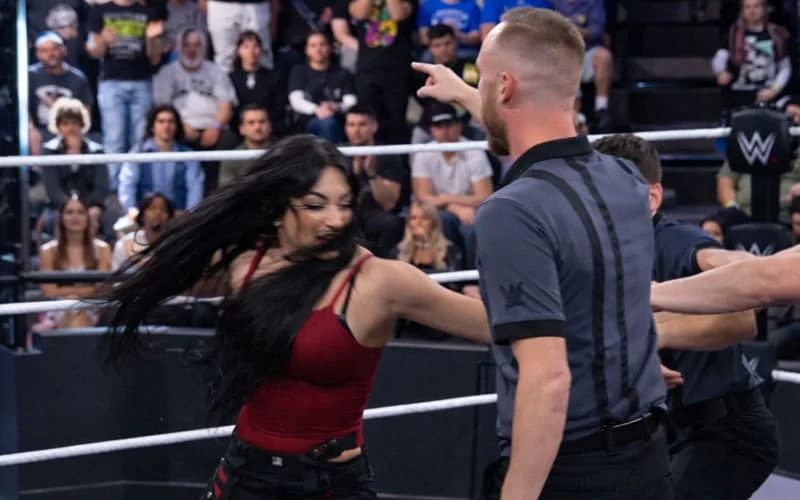
The rhetoric used by the champion only served to pour gasoline on an already smoldering fire. Dame’s insistence that she was the intellectual superior of the locker room was the breaking point for her rival. Just as the champion reached the peak of her self-congratulatory speech, the familiar and haunting strains of Tatum Paxley’s music cut through the air. The shift in the room was instantaneous. Paxley did not make a traditional entrance; she emerged with the singular focus of a predator. However, the NXT management, perhaps anticipating the exact explosion that was about to occur, had already deployed a wall of security personnel and official referees to the entryway. The visual was striking—a phalanx of black-shirted officials standing between a champion and a challenger who had clearly lost her grip on professional decorum. For a moment, it appeared as though order would be maintained, as the officials grappled with Paxley, attempting to usher her back toward the locker room area and prevent a physical altercation that could jeopardize the night’s proceedings.
It was in this moment of high tension that the situation devolved from a standard wrestling confrontation into a disciplinary nightmare. Paxley, feeling the literal and metaphorical weight of the officials holding her back, snapped. In a display of raw frustration and unhinged aggression, she lunged forward, not at the champion who was mocking her from the safety of the ring, but at the very people trying to keep the peace. One specific official found himself on the receiving end of Paxley’s fury when she delivered a devastating, targeted headbutt that sent him reeling. The physicality was jarring, even by the standards of a contact sport. The assault on a non-competitor is one of the ultimate taboos in the industry, a line that, once crossed, carries heavy administrative consequences. The ring officials, who are traditionally viewed as neutral entities meant to facilitate the rules of the game, are rarely subjected to such direct violence, and the impact of the strike left the surrounding crew in a state of shock.
While the chaos unfolded on the floor, Izzi Dame remained in the ring, a safe distance away from the carnage. Her reaction was a mixture of amusement and feigned horror, watching as the woman who had beaten her just a week prior was now being forcibly removed from the premises. The champion did not have to lift a finger to defend her title; the challenger’s own lack of emotional control had done the work for her. As security finally managed to get a handle on Paxley, dragging her toward the exit, the image was one of a fallen star. Paxley’s obsession with Dame and the championship had seemingly cost her her dignity and, potentially, her employment status. Following the outburst, reports surfaced quickly that Paxley had been unceremoniously kicked out of the building, a move sanctioned by the higher-ups to ensure that the rest of the television tapings could proceed without further disruption.
The immediate fallout of this incident places NXT General Manager Ava in a precarious position. The brand has worked tirelessly to establish the Women’s North American Championship as a prestigious prize, a symbol of the next generation of greatness. Having that title’s first major post-win segment end in a physical assault on a referee creates a public relations and disciplinary headache. Ava now faces the difficult task of determining a fit punishment for Paxley. In many wrestling jurisdictions, striking an official is grounds for an immediate and indefinite suspension, or at the very least, a substantial financial penalty. However, the complexity of the situation cannot be ignored. Paxley’s grievance, while expressed through violent and unacceptable means, is rooted in the fact that she holds a direct victory over the current champion. To remove Paxley from the equation entirely might solve the immediate behavioral problem, but it leaves the championship picture in a state of unresolved tension.
Furthermore, the character evolution of Tatum Paxley has reached a fascinating tipping point. For months, she has been portrayed as a figure lurking in the shadows, someone whose motivations are often opaque and whose actions are driven by an internal logic that few others understand. This latest outburst suggests a transition from "creepy" to "dangerous." By attacking an official, she has signaled that she no longer respects the boundaries of the promotion. This makes her a wildcard that Izzi Dame must eventually deal with, regardless of how many security guards are placed in her path. Dame, for her part, has successfully navigated her first week as champion by playing the role of the "thinking man’s" titleholder. She is leaning into the idea that she is a corporate-friendly, strategic asset to the brand, contrasting sharply with the chaotic energy of Paxley. This "order vs. chaos" dynamic is likely to be the driving force of the division for the foreseeable future.
Looking ahead, the question remains whether Izzi Dame can truly thrive as a champion with such a controversial origin story. While she holds the physical belt, the shadow of her loss to Paxley at New Year’s Evil looms large. Every time she defends the title, critics and fans alike will point to that January 6 defeat as evidence that she is a "paper champion." To silence those doubters, she will eventually have to step back into the ring with Paxley and prove that she can win without the benefit of a chaotic multi-person scenario or a fortunate turn of events. However, after the events of January 13, that match feels further away than ever. If Paxley is sidelined by a suspension, the title picture may have to move on to other challengers, leaving the rivalry to simmer in the background until the "unhinged" challenger is allowed back into the fold.
The January 13 episode of NXT will be remembered not for a classic wrestling match, but for the moment the thin veneer of professionalism in the women’s division was shattered. Tatum Paxley’s decision to strike an official has shifted the narrative from a quest for gold to a quest for control. As the brand moves toward its next major event, the eyes of the wrestling world are on Ava and the NXT creative team to see how they handle a competitor who has clearly lost her way. For Izzi Dame, the victory is bittersweet; she remains the champion, but she is now the target of a woman who has proven she has nothing left to lose. The road to the next title defense is now paved with uncertainty, legal ramifications, and the lingering threat of a loose cannon who refuses to be ignored. Whether this leads to a formal disciplinary hearing or a high-stakes grudge match, the intensity between these two women has reached a point of no return, ensuring that the Women’s North American Championship remains the most talked-about prize in developmental wrestling today. In the end, the headbutt heard ’round the Performance Center was more than just a physical strike; it was a declaration of war against the status quo, and the consequences will likely be felt for months to come.