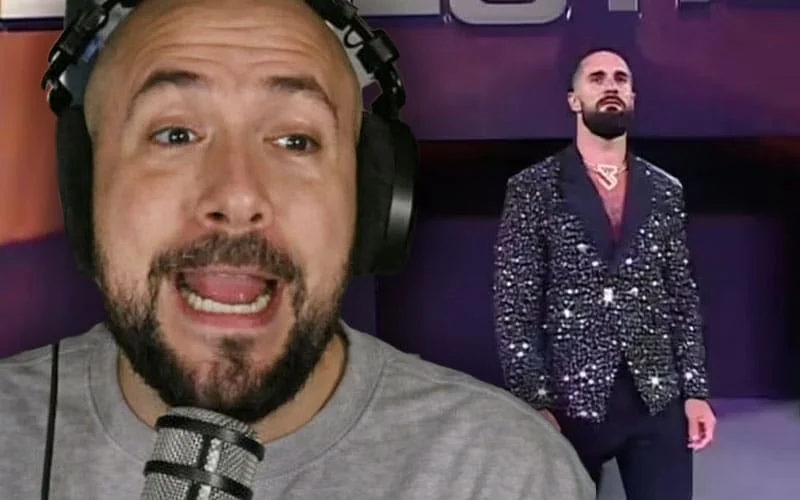
The intricate tapestry of professional wrestling has always been woven from the threads of reality and fiction, a concept traditionally known as kayfabe. In the modern era, where social media and behind-the-scenes reporting have pulled back the curtain further than ever before, the ability for a promotion to truly deceive its audience has become a rare and precious commodity. This delicate balance between what is genuine and what is scripted recently became the center of a heated intellectual skirmish involving some of the most prominent voices in wrestling media. At the heart of the disagreement was the portrayal of Seth Rollins and the physical toll his career has taken, specifically regarding the narrative surrounding his health in the lead-up to the most recent SummerSlam event. The conflict erupted when long-time radio personality and WWE analyst Peter Rosenberg took aim at the skeptical perspective offered by veteran journalists Dave Meltzer and Bryan Alvarez, sparking a broader conversation about the nature of belief in a sport defined by its artful deception.
The catalyst for this debate was the promotional material for the second season of a documentary-style series titled Unreal, which focuses on the high-stakes environment of the sports entertainment world. In the trailer for the upcoming season, the narrative suggested that a specific injury angle involving Rollins had successfully manipulated the perceptions of everyone watching, from the casual viewer to the most jaded industry insiders. This claim did not sit well with the duo at the Wrestling Observer, who often pride themselves on their ability to see through the smoke and mirrors of the creative process. Meltzer and Alvarez dismissed the idea that the audience had been genuinely misled, arguing instead that anyone with a modicum of insight into the industry recognized the situation as a scripted plot point from its inception. This dismissal, however, served as a lightning bolt for Rosenberg, who viewed their cynicism as a symptom of being too deeply entrenched in the clinical analysis of the business to appreciate the effectiveness of the performance.
Rosenberg’s rebuttal was not merely a defense of the company he works for, but a passionate argument for the enduring power of the "work." He contended that the journalists were so preoccupied with their own status as experts that they had lost touch with the actual experience of the viewing public. According to the analyst, the idea that the Rollins injury was an obvious fabrication is a revisionist history that ignores the genuine uncertainty that permeated the wrestling community at the time. To bolster his point, Rosenberg shared a personal anecdote that highlighted just how deep the deception ran. He revealed that he had spent time with Rollins for a private dinner just twenty-four hours before the SummerSlam festivities were set to begin. Despite his close proximity to the performer and his own extensive knowledge of the inner workings of the roster, Rosenberg admitted that he remained entirely unsure of what was real and what was part of the show.
This level of commitment to a narrative is what makes Seth Rollins one of the most compelling figures in the industry today. Known as the Visionary and the Revolutionary, Rollins has built a reputation as a workhorse who leaves everything in the ring. His history of legitimate, devastating injuries—most notably the ACL, MCL, and medial meniscus tears he suffered in 2015 while he was at the peak of his powers as the world champion—has created a foundation of vulnerability that the audience remembers. When Rollins appears to be hurt, the fans do not simply see a character in pain; they see a man whose body has been pushed to its absolute limit through years of high-flying maneuvers and grueling schedules. This historical context provided the perfect cover for a sophisticated injury angle, as the line between the physical toll of his real-life matches and the requirements of the storyline became indistinguishable.
The debate further intensified when Rosenberg noted that he wasn’t the only one left guessing. He mentioned that even fellow performers, such as the veteran powerhouse Big E, were engaged in active debates about the legitimacy of the Rollins situation. If a former world champion and locker room leader like Big E could find himself questioning the reality of the circumstances, it stands to reason that the creative team had achieved something remarkable. The essence of professional wrestling’s magic lies in that moment of doubt—the split second where a fan asks, "Is this actually happening?" Rosenberg argued that by dismissing this achievement, critics like Meltzer and Alvarez were ignoring the very thing that keeps the industry alive. The goal of a great storyline is not just to tell a story, but to create an emotional response that bypasses the logical brain’s desire to categorize everything as fake or staged.
Supporting Rosenberg’s stance was his frequent collaborator, Stat Guy Greg, who offered a more pointed critique of the journalistic approach taken by the Observer staff. He suggested that the claim of knowing the truth all along was less about superior analytical skills and more about the luck of the draw in the rumor mill. In the modern landscape, rumors are a currency, and often, if a journalist hears a whisper from a backstage source, they will present it as a foregone conclusion. Greg argued that hearing a rumor does not equate to having a profound understanding of the craft. Instead, it can often act as a barrier to enjoying the product, as it encourages a mindset where the goal is to "beat" the writers rather than go on the journey they have prepared. He posited that the Rollins angle was a masterclass in triggering the primal part of a wrestling fan’s mind—the part that has been conditioned for decades to bite on a well-placed hook.
This tension between the "insider" perspective and the "fan" experience is one of the oldest conflicts in wrestling media. On one side, you have the historians and reporters who treat the business like a traditional sport, analyzing contract statuses, creative meetings, and backstage politics. On the other, you have those who view it as a form of performance art, where the success of a segment is measured by how effectively it suspends the disbelief of the audience. The Rollins injury angle served as a perfect case study for this divide. For a journalist, the objective is to be right; for a performer and a storyteller, the objective is to make the audience feel something. When those two goals clash, you get the kind of public disagreement that Rosenberg initiated. He seemed particularly bothered by the implication that the fans are "marks" who are easily fooled, arguing instead that even the most educated viewers want to be taken for a ride.
The broader implications of this spat touch upon how wrestling is consumed in the twenty-first century. With the rise of "behind-the-scenes" content like the Unreal series, the industry is increasingly leaning into a meta-narrative. They are no longer just telling stories about champions and challengers; they are telling stories about the business of telling stories. This adds a new layer of complexity to the performer’s job. Seth Rollins wasn’t just selling a knee injury to his opponent in the ring; he was selling the idea of his own mortality to a global audience that has access to his medical history and his social media updates. To navigate that landscape and still manage to create a "reveal" that catches people off guard is a testament to the sophistication of modern WWE production.
As the discussion continued, it became clear that the frustration felt by Rosenberg and his peers was rooted in a desire to protect the "sanctity of the work." In an age where every plot twist is leaked weeks in advance and every creative decision is scrutinized by armchair bookers, the ability to pull off a genuine surprise is a victory for the art form. The Rollins angle leading into SummerSlam was designed to be a pivot point for the summer’s biggest storylines, involving high-profile names and championship implications. By casting doubt on Rollins’ physical status, the company was able to heighten the stakes for his matches, making every move he made look like a potential disaster. This psychological layer added a depth to the matches that would have been missing if everyone had simply walked into the arena knowing it was a predetermined script.
Furthermore, the role of personalities like Peter Rosenberg in this ecosystem cannot be understated. As someone who bridges the gap between traditional sports broadcasting and the specialized world of wrestling, he brings a different perspective to the table than someone who has only ever covered the squared circle. He understands the value of the "big game" feel and the necessity of high-drama stakes. When he speaks about being fooled, he is speaking as a representative of the audience that still wants to believe, even if they know the underlying truth. His critique of Meltzer and Alvarez was a defense of that fan’s right to be immersed in the story without having the "smart" perspective forced upon them as the only valid way to watch.
The fallout from this debate also highlights the evolving nature of Seth Rollins’ legacy. Often compared to the greats like Shawn Michaels or Bret Hart for his technical proficiency, Rollins has now entered a phase of his career where his character work is just as vital as his in-ring performance. By successfully navigating the "real vs. unreal" narrative, he has proven that he is a master of the psychological aspects of the business. He managed to turn his real-life wear and tear into a weapon that he could use to manipulate the audience’s emotions, a move that requires a high level of trust between the performer and the creative team.
Ultimately, the clash between Rosenberg and the Wrestling Observer duo is a reflection of the state of wrestling in 2024. It is a world where the truth is often less interesting than the fiction, and where the most successful performers are those who can live in the space between the two. Whether the Rollins injury angle was a "brilliant reveal" or a "transparent ploy" depends entirely on what the viewer is looking for when they tune in. For those who want to analyze the business from a distance, the transparency of the industry is a tool for critique. But for those like Rosenberg, who still find joy in the spectacle, the ability to be worked is not a sign of ignorance—it is the ultimate reward for being a fan. The debate over the Unreal trailer and the Rollins health saga may fade, but the fundamental question of how we perceive reality in wrestling will continue to provoke passion and division for as long as the ring ropes are tight and the lights are bright. In the end, perhaps the greatest trick the wrestling industry ever pulled wasn’t convincing the world that it was real, but convincing a skeptical audience to care enough to argue about what is real in the first place.