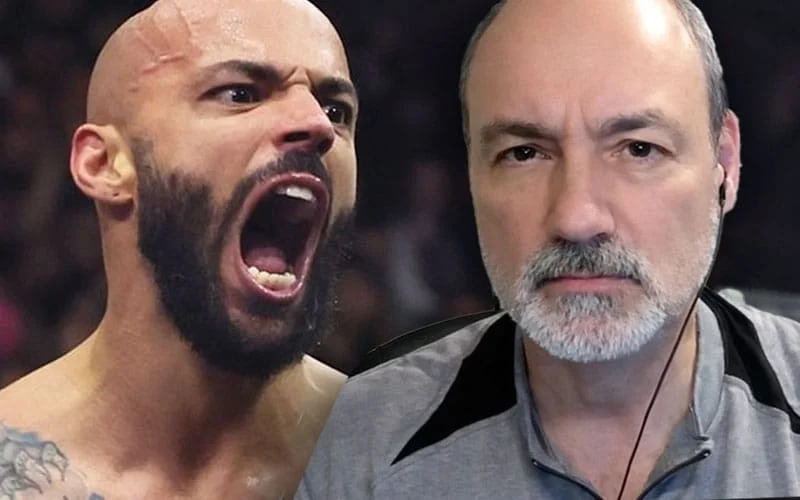
The landscape of professional wrestling has always been a volatile mix of scripted drama and very real backstage friction, but the digital age has allowed these tensions to spill over into the public eye with unprecedented frequency. In early February 2026, the industry witnessed one of the most aggressive and personal exchanges in recent memory, centered on the current AEW National Champion, Ricochet. Known for his gravity-defying maneuvers and soft-spoken demeanor for much of his career, the man once heralded as one of the greatest high-flyers in history has recently adopted a much more vocal and confrontational stance regarding his professional journey. This shift reached a boiling point following a series of public comments regarding his tenure with his former employer, World Wrestling Entertainment, and the subsequent rebuttal from a veteran official that ignited a firestorm of controversy across social media platforms.
The conflict began to take shape on February 4, 2026, when Ricochet took to the internet to express a deep-seated frustration that had clearly been simmering since his departure from the global wrestling leader. He didn’t merely critique the creative direction of his matches; he leveled a profound accusation against the corporate culture of WWE, suggesting that the environment was fundamentally designed to erode a performer’s passion for the craft. According to the National Champion, his years spent within that system had a transformative, negative effect on his psyche, turning him into a mere shadow of the innovative artist who had captivated audiences in Japan and on the independent circuit. He lamented that the constant grind and the specific demands of the sports entertainment giant had effectively drained him of his love for professional wrestling, a sentiment he claimed was shared by a significant portion of the roster who remain under that banner.
By the following day, the situation escalated when Jimmy Korderas, a man whose name is synonymous with the officiating side of the business due to his long tenure as a WWE referee, decided to weigh in on the matter. Korderas, who often provides analysis on the modern product from the perspective of a seasoned veteran, found Ricochet’s public venting to be unprofessional. The crux of the referee’s argument rested on the timeline of Ricochet’s employment. Korderas posited that if the environment was truly as toxic or soul-crushing as described, the wrestler would not have remained with the organization for over half a decade. Specifically, the official alleged that Ricochet had made a conscious choice to extend his stay by signing a new contract in 2022, several years into his run. Furthermore, Korderas took issue with the champion mentioning other active WWE superstars, such as Finn Balor, Shinsuke Nakamura, and Apollo Crews, as examples of talent whose spirits were being broken. The veteran official characterized this "name-dropping" as a poor reflection on Ricochet’s character rather than a valid critique of the company.
The response from the AEW star was immediate, visceral, and notably profane. Rather than ignoring the criticism from the retired official, Ricochet opted for a direct and aggressive confrontation that sought to dismantle the factual basis of the veteran’s claims. In a series of heated messages, the champion clarified the specifics of his legal history with WWE, asserting that he had only ever signed a single five-year agreement in 2019. He vehemently denied the existence of any 2022 extension, stating that his original contract simply reached its natural conclusion in 2024, at which point he chose to walk away and seek a fresh start elsewhere. This revelation was significant, as it challenged the narrative that he had willingly "doubled down" on a system he claimed to despise.
Perhaps the most revealing aspect of this rebuttal was Ricochet’s claim regarding his Intercontinental Championship reign. He suggested that his time as a titleholder was not a reward for his hard work or a sign of creative faith, but rather a strategic maneuver by the office to keep him tethered to the company. The National Champion alleged that he had actively requested his release from his contract during that period, only to be met with a refusal. In his view, the decision to put a prestigious title around his waist was a hollow gesture intended to placate him and potentially convince him to stay longer, despite his clear desire to leave. This perspective sheds a new light on the 2022 period of his career, suggesting that behind the scenes, one of the company’s most talented performers was essentially working against his will while carrying a championship he no longer valued.
The intensity of this exchange highlights a growing divide in the wrestling world between the traditionalists, represented by figures like Korderas, and the modern athlete, represented by Ricochet. For the older generation, there is often an unwritten rule about loyalty and "protecting the business," which includes keeping grievances behind closed doors and showing gratitude for the opportunities provided by the industry’s largest platform. To Korderas, complaining about a company while having accepted their paychecks for years seems like an act of betrayal or, at the very least, a lack of personal accountability. From this viewpoint, if a wrestler is unhappy, they should simply wait for their contract to end or handle their exit with quiet dignity.
Conversely, Ricochet’s outburst represents a new era of transparency where wrestlers are no longer willing to remain silent about the mental and creative toll of the industry. His mention of Balor, Nakamura, and Crews was particularly pointed. All three are world-class performers who arrived in WWE with massive reputations from the international scene, only to find themselves frequently lost in the shuffle of a massive corporate machine. By citing them, Ricochet was pointing to a perceived pattern of "burning out" top-tier talent, transforming them from unique attractions into replaceable cogs in a wheel. The fact that he felt the need to speak for them, despite Korderas’s disapproval, suggests he views himself as a voice for those who may not feel empowered to speak for themselves while still under contract.
The broader context of Ricochet’s career makes this frustration more understandable. Before ever stepping foot in a WWE ring, he was a revolutionary figure. As Prince Puma in Lucha Underground and a standout in New Japan Pro-Wrestling, he helped redefine what was possible in terms of athleticism and aerial offense. When he signed with WWE in 2019, expectations were sky-high. His initial run in NXT, which included a North American Championship victory, seemed to indicate that he would be a cornerstone of the future. However, his transition to the main roster was a rollercoaster of brief pushes and long periods of inactivity. While he held the United States Championship and the Intercontinental Championship, he often found himself in short matches or relegated to secondary shows, which many fans felt was a waste of his generational talent.
The move to AEW has clearly revitalized him, and his current status as National Champion is a testament to his desire to prove his worth on his own terms. However, the scars of his previous tenure clearly remain. The vitriol directed at Korderas was not just about a contract dispute; it was the release of years of pent-up resentment. When he accused the veteran official of failing to do proper research, he was also attacking the perceived ignorance of those who defend the corporate structure without understanding the individual struggles of the performers. The use of harsh language and personal insults indicated that the champion was no longer interested in maintaining a "professional" facade if it meant allowing what he considered to be lies to circulate.
This incident also underscores the power and the peril of social media in the wrestling industry. Platforms like X (formerly Twitter) have become the primary battleground for narrative control. For a wrestler like Ricochet, it provides a direct line to the fans, allowing him to bypass the "spin" of corporate PR and tell his side of the story. Yet, it also invites immediate conflict with figures from the past who hold different values. The speed at which this escalated—from a general comment about creative burnout to a profanity-laced argument about contract dates—shows how quickly the industry’s internal politics can become a public spectacle.
The debate over Ricochet’s "shell of himself" comment is particularly poignant. It speaks to a phenomenon often discussed by wrestling critics where the "WWE style"—a more controlled, television-centric approach to wrestling—can sometimes homogenize talent. For a performer whose entire identity was built on being a "one-of-a-kind" athlete, the pressure to conform to a specific mold can be devastating. Ricochet’s assertion that the company "kills the love" of the sport is a heavy indictment, suggesting that the dream of reaching the "top" can often turn into a nightmare of creative stagnation and emotional exhaustion.
As the dust settles on this specific confrontation, the questions it raised remain. The accuracy of the contract claims—whether it was one five-year deal or an extension—is a matter of legal record that may eventually be clarified, but the emotional truth behind Ricochet’s words is what has resonated most with the wrestling community. His refusal to back down or apologize for his language signals a new chapter in his career, one defined by an uncompromising honesty. He is no longer just the "King of Flight"; he is a veteran who has survived the system and is now intent on exposing its flaws, regardless of whose toes he steps on.
Ultimately, this clash between the AEW National Champion and the former WWE official is a microcosm of the current state of the industry. It is a world where the lines between reality and persona are increasingly blurred, where historical loyalty is being challenged by personal well-all-being, and where the fight for creative freedom is being waged in 280 characters or less. Ricochet has made it clear that he has rediscovered his passion for the ring, but he has also shown that he will not let his past be rewritten by those who weren’t in the trenches with him. Whether one views his response as a justified defense of his truth or an unnecessary explosion of anger, there is no denying that the National Champion is more focused, more vocal, and more dangerous than he has ever been. The wrestling world will undoubtedly be watching to see if this newfound fire continues to fuel his performances in the ring or if the ghosts of his previous career will continue to haunt his public discourse. For now, Ricochet has drawn a line in the sand, making it known that his silence can no longer be bought, even with a championship belt.