Professional wrestling, at its heart, is a vibrant tapestry woven from athletic spectacle, compelling narratives, and larger-than-life personalities. Yet, in an era dominated by instantaneous digital communication, the story of wrestling extends far beyond the confines of the squared circle and the bright lights of weekly television. It’s in the candid glimpses behind the curtain, the unfiltered statements that blur the lines between performer and character, and the shared moments that reveal the human element beneath the elaborate personas. This past period has offered a particularly rich collection of such insights, showcasing the diverse facets of the industry – from the uncompromising dedication to villainy by a reigning champion, to the awe-inspiring feats of athleticism demonstrated in the gym, the personal connections that ground performers, and the sheer physical grind required to thrive at the highest level. These digital dispatches, often raw and unpolished, collectively paint a comprehensive picture of a sport that never truly goes off-air, where every action, every declaration, and every shared moment contributes to an ongoing, evolving narrative that captivates audiences worldwide.
At the forefront of stirring the pot, as always, is Maxwell Jacob Friedman, better known simply as MJF, the reigning AEW World Champion and arguably the most compelling antagonist in professional wrestling today. His persona as the "Salt of the Earth" is built upon an unyielding arrogance, a profound disdain for the common fan, and a talent for eliciting visceral reactions that few in the industry can match. This mastery of his craft was on full display during AEW’s momentous debut in Australia for Revolution, a pivotal event that marked a significant international expansion for the promotion. Despite the overwhelming support for AEW in Melbourne, MJF, ever the provocateur, wasted no opportunity to remind the Australian faithful precisely how little he cared for their adoration or their country. His social media activity during this period was a masterclass in heel work, doubling down on his contempt and ensuring that every single fan felt his deliberate disrespect. This wasn’t merely a casual insult; it was a calculated maneuver designed to amplify his character, to solidify his standing as the villain everyone loves to hate.
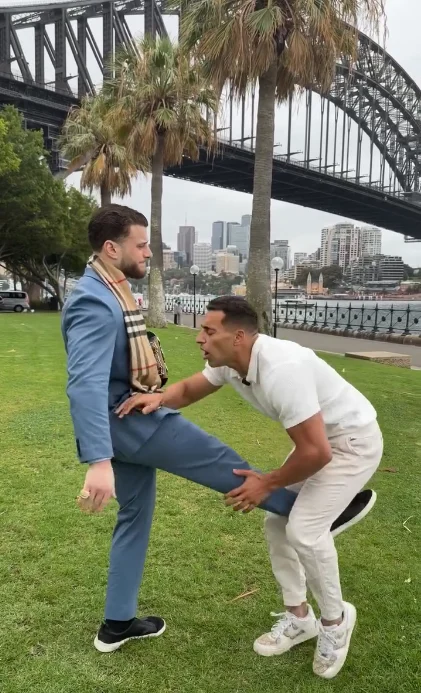
One particularly memorable interaction saw MJF engage with local media personality Jon-Bernard Kairouz. Kairouz, perhaps hoping to extract an apology or at least a moment of softened demeanor from the champion, was met with the full force of Friedman’s unwavering heel disposition. The exchange, played out for public consumption, served as a stark reminder that MJF does not break character, especially not for the sake of politeness or public relations. He thrives on the animosity, feeding off the collective boos and jeers that follow him across continents. This commitment to his character, even in non-wrestling contexts, is a testament to why he holds the top title in AEW. He understands that the magic of professional wrestling lies in the suspension of disbelief, and he is a grand illusionist, ensuring that the audience never truly forgets who he is, even when the cameras aren’t rolling on Dynamite or Collision. His refusal to offer any form of contrition for his remarks about Australia wasn’t just a fleeting social media post; it was an integral piece of his ongoing narrative, reinforcing his self-proclaimed superiority and cementing his status as the most arrogant, yet undeniably talented, individual in the business. This ability to generate authentic heat, to make audiences genuinely invested in his eventual comeuppance, is a rare commodity and a cornerstone of his championship reign.
Shifting gears from calculated villainy to breathtaking athleticism, the wrestling world was recently treated to an extraordinary display of physical prowess from NXT’s rising star, Sol Ruca. Hailing from a background steeped in competitive gymnastics and collegiate surfing, Ruca brings a unique blend of agility, power, and grace to the squared circle. Her "Sol Snatcher" finisher, a twisting, flipping, mid-air stunner, has already become a highlight reel staple, showcasing her incredible body control and innovation. However, a recent gym footage shared widely across social platforms offered a more intimate look at the raw athleticism that underpins her in-ring marvels. The video captured Ruca executing a "skin the cat" maneuver, a demanding gymnastic move that requires immense upper body strength, core stability, and flexibility. This involves hanging from a bar, rotating the body upside down, and passing the legs and torso through the arms, effectively "skinning" oneself over the bar.
The ease and fluidity with which Ruca performed this challenging exercise were nothing short of astonishing. It wasn’t just a demonstration of strength; it was a testament to her lifelong dedication to physical excellence, a commitment that translates directly into her captivating performances in the ring. What made this particular gym moment even more engaging was its impromptu "teaching" session with WWE veteran Sheamus. The "Celtic Warrior" himself, known for his rigorous "Celtic Warrior Workouts" and impressive physique, found himself attempting to replicate Ruca’s acrobatic feat. While Sheamus is a powerhouse of a different caliber, focusing on brute strength and hard-hitting offense, the contrast in their approaches highlighted the diverse athletic requirements of professional wrestling. His good-natured attempts, even if not as fluid as Ruca’s, added a layer of fun and camaraderie, demonstrating how wrestlers, regardless of their standing or style, continuously learn from and inspire one another in their pursuit of physical perfection. Ruca’s "double dip" of this maneuver, performing it multiple times with seemingly effortless grace, solidified her reputation as one of the most naturally gifted athletes on the entire WWE roster, hinting at a future filled with high-flying, innovative wrestling spectacles. These glimpses into the rigorous training regimens of performers like Ruca and Sheamus underscore the immense physical sacrifices and dedication required to maintain peak condition for the demanding schedule of professional wrestling.
Another formidable presence who consistently demonstrates the sheer grind behind the scenes is Jordynne Grace, the "Juggernaut" of IMPACT Wrestling. Known for her unparalleled strength and imposing physique, Grace has carved out a niche as one of the most dominant women in the industry, holding the Knockouts World Championship on multiple occasions. Her social media presence often provides candid insights into her intense training sessions, showcasing the relentless effort she pours into maintaining her powerful build. Recently, Grace shared a glimpse into her personal gym routine, revealing the kind of heavy lifting and high-intensity workouts that are foundational to her wrestling style. These aren’t just superficial exercises; they are carefully constructed regimens designed to enhance her power, endurance, and resilience, all critical components for a wrestler whose offense relies heavily on throws, slams, and formidable submissions.
Grace’s dedication serves as a powerful reminder that the larger-than-life characters seen on television are built on a foundation of disciplined training away from the spotlight. For someone like Grace, whose persona is intrinsically linked to her physical strength, every rep, every set, and every training session is a reinforcement of her "Juggernaut" moniker. Her commitment not only inspires fans but also sets a benchmark for what it means to be a top-tier athlete in professional wrestling. It’s a testament to the fact that while charisma and character are vital, the physical readiness to perform at an elite level, day in and day out, is non-negotiable. These behind-the-scenes looks at Grace’s unwavering commitment to the gym offer a deeper appreciation for her accomplishments in the ring and highlight the often-unseen sacrifices that contribute to a wrestler’s longevity and success.
In a similar vein of physical conditioning and camaraderie, a lighthearted but insightful interaction involving Indi Hartwell and Steph De Lander surfaced. Both women have made their mark in WWE’s NXT system, though their paths have diverged, with De Lander exploring opportunities outside the company. The exchange revolved around the "skull crusher" exercise, a triceps-building movement that, as its name subtly suggests, can be perilous if performed incorrectly. Hartwell and De Lander, whether in person or through a shared digital space, appeared to have differing philosophies or execution styles for the exercise. This small moment, seemingly trivial, actually offers a window into the nuanced world of professional fitness and the individual preferences that even elite athletes develop. It highlights that while common exercises exist, personal technique, biomechanics, and training goals can lead to varied approaches. More importantly, it showcased a friendly interaction between peers, underscoring the supportive, albeit sometimes competitive, environment that exists among wrestlers, even those from different promotions or at different stages of their careers. It’s a glimpse into the shared experience of pushing physical limits and refining one’s craft, an experience that often fosters genuine friendships and mutual respect within the wrestling community.
The world of wrestling also continuously seeks out new talent that can captivate audiences with unique in-ring abilities. Jack Cartwheel, an independent wrestling sensation, recently made waves with his official WWE arrival video. Typically, these introductory packages can feel formulaic, offering standard gym shots and boilerplate statements. However, Cartwheel’s video broke the mold, resonating with fans and critics alike due to its genuine portrayal of his distinct, acrobatic style. Cartwheel, whose independent circuit reputation is built on breathtaking flips, innovative counters, and a seemingly boundless energy, managed to translate that essence into his WWE introduction. The video likely showcased not just his physical feats but also his infectious personality, hinting at the charisma that could make him a breakout star in NXT. It served as a reminder that while WWE’s production values are unmatched, it’s the individual character and unique skill set of a performer that truly allows them to stand out. His arrival video was not a mere formality; it was a statement that a new, dynamic force had entered the WWE ecosystem, promising a future filled with high-octane, gravity-defying performances that could redefine what fans expect from a "superstar."
Adding another layer of character-driven engagement, the tag team known as The Outrunners, consisting of Turbo Floyd and Truth Magnum, provided a moment of quirky charm. Their retro 80s aesthetic and commitment to a bygone era of wrestling often lend themselves to humorous, off-kilter scenarios. Their recent online activity suggested a desire to star in a nature documentary, particularly one set in Australia. This idea, while seemingly random, perfectly encapsulates their comedic timing and their ability to blend their wrestling persona with an absurd, yet endearing, sense of self-awareness. It subtly connects back to the theme of AEW’s international ventures, perhaps playfully suggesting they too should embark on a journey Down Under, albeit for a far less combative purpose than MJF’s championship defense. The Outrunners, who have primarily showcased their talents on AEW’s Dark and Elevation programs, understand the importance of creating memorable moments, even outside the ring, to build their brand and connect with an audience. Their desire for a nature documentary underscores their unique approach to their craft, demonstrating that character work can extend beyond traditional wrestling tropes into unexpected and amusing territories, creating an enduring impression on fans.
The narrative of perseverance and recovery found its champion in Rick Boogs. Known for his infectious energy, guitar-shredding entrances, and impressive power-lifting feats, Boogs quickly became a fan favorite in WWE. However, his promising trajectory was abruptly halted by a severe quadriceps injury sustained at WrestleMania 38. The road to recovery for such a debilitating injury is long and arduous, testing not only a wrestler’s physical resilience but also their mental fortitude. Recently, updates on Boogs have highlighted his continued journey back to full strength and his unwavering positive outlook. His social media activity often reflects his buoyant personality, showcasing his dedication to rehabilitation while maintaining his signature enthusiasm. These glimpses into his life remind us of the fragility of a wrestler’s career and the immense challenges they face when sidelined by injury. Boogs’s determination to return, coupled with his ability to keep fans engaged and entertained even while away from the ring, speaks volumes about his character. His continued presence, albeit outside the immediate wrestling spotlight, serves as an inspiring testament to the fighting spirit inherent in professional wrestlers, eagerly anticipating the moment when he can once again electrify arenas with his unique blend of strength and showmanship.
Beyond the grueling training and in-ring exploits, wrestlers also share glimpses into their personal lives, grounding their larger-than-life personas in relatable human experiences. Mercedes Moné, a name synonymous with breaking barriers and forging new paths, recently offered such a moment. After a storied career as Sasha Banks in WWE, Moné embarked on an unprecedented journey, taking her talents to NJPW and STARDOM, where she quickly captured gold and established herself as a global force. While her professional endeavors have been highly publicized, her personal life is often kept more private. However, a recent photo shared on social media revealed a tender moment with her beloved "beast," Mortos, a charming canine companion. This snapshot offered fans a rare glimpse into the softer side of the "CEO" of professional wrestling. Wrestlers often cultivate intimidating or dominant personas, but moments like these humanize them, showing them as individuals with cherished pets and personal connections. It reminds the audience that behind the fierce competitors and elaborate characters are real people who find solace and joy in their personal lives. For Moné, this small shared moment resonated with her fanbase, allowing them to connect with her on a more intimate level, appreciating the balance she strikes between her relentless professional drive and her personal well-being.
Moving further into the realm of post-wrestling life, the enigmatic Ryback recently surfaced in a digital context, described as being busy with "Bug Guy things." Ryback, a former WWE Intercontinental Champion known for his powerful offense and "Feed Me More" catchphrase, transitioned away from mainstream wrestling several years ago to pursue other ventures. While the specifics of his "Bug Guy things" are left to interpretation, it likely refers to personal interests, entrepreneurial pursuits, or perhaps a niche hobby that has captured his attention outside the wrestling industry. Many former wrestlers, after years on the road and under the spotlight, choose to step away and explore different passions, whether it’s health and wellness, business, or simply a more private life. Ryback’s journey post-WWE has been characterized by outspoken commentary and a focus on personal growth and alternative health. This brief mention serves as a reminder that the careers of professional wrestlers often extend beyond their time in the ring, with many finding new avenues for fulfillment and purpose. It speaks to the diverse paths individuals take after their wrestling chapters conclude, showcasing that life after full-time competition can be just as dynamic, albeit in different ways, as their in-ring careers.
Finally, the emotional spectrum of professional wrestling was rounded out by a montage of affectionate moments captured within All Elite Wrestling. The compilation, which highlighted "steamy kisses" and displays of affection between various AEW personalities, underscored the role of romance and personal connection in the wrestling narrative. Whether these relationships are part of a storyline or represent real-life couples who choose to share their bond with the audience, they add a crucial layer of depth and relatability to the wrestling product. AEW, in particular, has often embraced incorporating real-life relationships into its programming, such as Adam Cole and Britt Baker, Kip Sabian and Penelope Ford, or Miro and CJ Perry (Lana). These public displays of affection, far from being mere fluff, serve several purposes. They humanize the performers, allowing fans to see a more vulnerable or loving side to their characters. They can fuel storylines, creating compelling angles around jealousy, loyalty, or betrayal. Most importantly, they connect with the audience on an emotional level, tapping into universal themes of love and partnership. The "feel the love" sentiment accompanying these images emphasizes that professional wrestling, for all its physicality and theatricality, is also about human emotion and connection, resonating with fans who invest not just in the matches, but in the intricate relationships that bind the wrestling world together.
In conclusion, the modern wrestling landscape is a multifaceted entity, constantly evolving and expanding beyond the traditional boundaries of live events and television broadcasts. The recent collection of digital insights offers a compelling snapshot of this dynamic world, where the unyielding dedication of a champion like MJF to his villainous craft stands in stark contrast to the breathtaking athletic artistry of Sol Ruca. We see the relentless physical commitment exemplified by Jordynne Grace and the friendly rivalries in training between Indi Hartwell and Steph De Lander. The unique charisma of newcomers like Jack Cartwheel promises a vibrant future, while the comedic stylings of The Outrunners demonstrate the enduring power of character. The resilience of Rick Boogs in recovery inspires, and the personal moments shared by Mercedes Moné offer a glimpse into the human heart of a global superstar. Even the post-wrestling endeavors of individuals like Ryback remind us of the diverse paths taken by those who have graced the squared circle. Ultimately, from the heated controversies to the tender embraces, these moments, shared across digital platforms, serve to enrich the wrestling narrative, deepen fan engagement, and continuously affirm that the world of professional wrestling is a truly unparalleled blend of sport, entertainment, and genuine human drama, always offering new threads to explore in its ever-unfolding story.