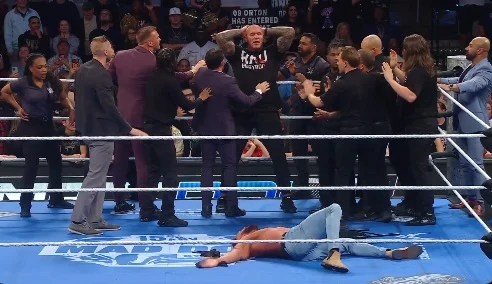
The palpable tension hanging over Friday Night SmackDown reached a fever pitch this past week as Randy Orton, the enigmatic "Apex Predator" of World Wrestling Entertainment, delivered a chilling reminder of his capacity for unbridled brutality. In a segment that began with the pretense of reconciliation and ended in a sickening display of violence, Orton orchestrated a meticulously crafted assault on Matt Cardona, leaving the veteran performer clutching his severely injured arm and the WWE Universe questioning the true intentions behind the Viper’s latest actions. This calculated act of aggression, culminating in a vicious stomp to Cardona’s limb on a steel chair, has sent shockwaves through the locker room and reignited speculation about Orton’s psychological state and his looming confrontation with Cody Rhodes.
The narrative threads leading to this disturbing event began to unravel earlier in the evening, during a backstage encounter that perfectly encapsulated the volatile nature of Randy Orton’s character. Matt Cardona, a seasoned competitor known for his independent wrestling success and previous tenure within WWE, bravely confronted Orton regarding the heinous assault on Cody Rhodes at the conclusion of the previous week’s broadcast. Cardona, seemingly driven by a sense of loyalty or perhaps a misplaced bravado, voiced his displeasure over Orton’s bloodthirsty attack on Rhodes. His words, however, only served to ignite the Viper’s notoriously short fuse. Orton, in a display of his characteristic arrogance and disdain, swiftly dismissed Cardona with a barrage of derisive insults, branding him an "unremarkable enthusiast" and a "fringe competitor" before unceremoniously leveling him with a swift, decisive blow. This initial confrontation established Cardona as a target, setting the stage for the evening’s dramatic climax.
Following this initial skirmish, the situation appeared to be defused, at least superficially, by the intervention of SmackDown General Manager Nick Aldis. Recognizing the potential for unchecked chaos that Orton’s presence often brings, Aldis prudently denied Cardona’s impassioned plea for an immediate match against the volatile superstar. Aldis’s decision, likely aimed at maintaining order and preventing further escalation, inadvertently paved the way for Orton to execute his sinister plan on his own terms. It was in this moment of administrative intervention that the unexpected figure of Grammy-winning musician Jelly Roll entered the frame. The acclaimed artist, seemingly acting as a voice of reason, engaged Orton in a rare, candid conversation backstage. Jelly Roll implored Orton to resist the darker impulses that have historically defined his career, urging him to strive for a better version of himself and to make amends for his recent transgressions, specifically suggesting an apology to Cardona. To the surprise of many, Orton appeared to concede, agreeing to extend an olive branch to his earlier victim in the main event segment.
However, the wrestling world has long learned to be wary of Randy Orton’s promises of redemption. His career is littered with instances where apparent shifts in alignment have merely served as elaborate ruses, designed to lull opponents into a false sense of security before unleashing a torrent of violence. Just moments before his scheduled in-ring apology, Orton received a mysterious phone call backstage. The content of this conversation remained obscured, yet the subtle shift in Orton’s demeanor – a fleeting glint in his eye, a barely perceptible tightening of his jaw – hinted at a pre-existing agenda, a deeper machination at play that would soon be revealed. This cryptic interaction served as a crucial narrative beat, signaling to astute observers that the promised apology was likely nothing more than a prelude to something far more sinister.
As the main event segment commenced, the atmosphere within the arena was thick with anticipation. Randy Orton, with his characteristic slow, deliberate walk, made his way to the squared circle, a coiled serpent seemingly ready to strike. Matt Cardona, perhaps emboldened by Jelly Roll’s intervention or simply underestimating the depths of Orton’s cunning, accepted the invitation to join him. The scene that unfolded was a masterclass in psychological warfare. Orton, feigning sincerity, extended his hand, coercing Cardona into accepting a superficial apology and a handshake that felt more like a trap than a gesture of peace. The crowd, sensing the impending betrayal, held its collective breath.
The moment of truth arrived with brutal efficiency. Just as Cardona seemed to relax, a flicker of relief crossing his face, Orton’s true intentions manifested in a horrifying flash. The Viper, without warning, delivered a devastating low blow, a gut-wrenching kick directly to Cardona’s groin. The unexpected, cowardly nature of the attack sent a wave of gasps through the audience. As Cardona writhed in agony on the canvas, a flurry of WWE officials, including General Manager Nick Aldis, rushed to the ring, attempting to intervene and restore order. Their pleas, however, fell on deaf ears. Orton, his eyes burning with a cold, predatory fire, appeared to be listening to a different voice entirely – the infamous "voices in his head" that have long been a terrifying hallmark of his most destructive phases.
Ignoring the desperate pleas and frantic efforts of the officials, Orton’s focus narrowed with chilling intensity. His gaze fixed upon a steel chair, a weapon synonymous with his most heinous acts of destruction. With deliberate, almost theatrical precision, he retrieved the chair, positioned it over Cardona’s prone left arm, and delivered a sickening, career-altering stomp. The impact resonated throughout the arena, a sickening thud that sent shivers down the spines of onlookers. The act was swift, brutal, and undeniably effective, designed to inflict maximum damage and send an unequivocal message. As Cardona screamed in agony, clutching his seemingly shattered limb, the crowd’s reaction was a chilling testament to Orton’s enduring anti-hero appeal. A significant portion of the audience, morbidly captivated by the violence, erupted into a chant of "One More Time!" a disturbing echo of their twisted admiration for the Legend Killer’s unhinged methods.
This latest act of barbarism isn’t an isolated incident but rather a potent continuation of a long and storied career defined by moments of shocking betrayal and calculated violence. Randy Orton’s legacy is intricately woven with instances of him turning on allies, brutalizing legends, and leaving a trail of destruction in his wake. From his early days as the "Legend Killer," systematically dismantling icons of the industry, to his stints in factions like Evolution and Legacy, where he often ascended to power through treacherous means, Orton has consistently demonstrated a profound capacity for cruelty. The "RKO Outta Nowhere" isn’t just a finishing maneuver; it’s a metaphor for his character – sudden, unexpected, and devastating. The "Voices in My Head" motif, introduced early in his career, serves as a narrative device to explain his unpredictable shifts from methodical strategist to unhinged psychopath. His recent behavior, culminating in the savage attack on Cardona, suggests a full immersion back into the darkest recesses of this complex persona.
The significance of Cardona’s appearance, though brief and painful, cannot be understated. While not a regular fixture on current WWE programming, Matt Cardona has cultivated a reputation as a resilient, innovative performer on the independent circuit. His challenge to Orton, however ill-advised, represented a clash of philosophies: the established, often corporate-backed brutality of a WWE main-eventer versus the grassroots, fan-supported spirit of an indie darling. Orton’s dismissive "indie nerd" comment was more than just an insult; it was a territorial declaration, a symbolic put-down of a different wrestling ecosystem, executed with the physical dominance that only a superstar of Orton’s caliber can wield. Cardona, in this context, served as a sacrificial lamb, his pain a stark message to anyone who dares to question the Viper’s authority or methods.
The broader implications of this incident, however, extend far beyond Matt Cardona’s immediate recovery. Orton himself hinted at his next target during the segment, casually mentioning his intention to "apologize" to Cody Rhodes next week. This statement, delivered with a chilling smirk, solidified the widely held belief that Orton’s recent actions are all part of a larger, more elaborate scheme targeting "The American Nightmare." The history between Orton and Rhodes is a rich tapestry of shared triumphs and bitter rivalries. As mentor and protégé in the Legacy faction, they dominated the tag team division, only for Orton to eventually turn on Rhodes, igniting a deeply personal feud. Rhodes’s journey "back to the promised land" of WWE has been a story of redemption, a narrative arc that Orton, with his penchant for shattering dreams, seems intent on disrupting.
The "mystery person" on the phone further complicates the narrative. Is it an outside influence pulling Orton’s strings, a puppet master manipulating the Viper for their own nefarious ends? Or is it merely a narrative device, a way to externalize the internal "voices" that drive Orton’s malevolent decisions? The identity of this caller, if ever revealed, could dramatically alter the trajectory of this unfolding storyline, potentially revealing a grander conspiracy or a new faction emerging to challenge the established order. Regardless, the call immediately preceding the attack on Cardona strongly suggests a premeditated plan, not a spontaneous outburst, further solidifying Orton’s role as a cold, calculating antagonist.
From a booking perspective, Orton’s current trajectory is a masterclass in character work. By operating in this morally ambiguous space, where his actions are undeniably villainous yet evoke a conflicted cheer from a segment of the audience, WWE is leveraging the inherent complexities of the "Apex Predator." This approach allows for a dynamic storyline, one where Orton can seamlessly transition between face and heel, depending on his opponent and the context of the feud. His current targeting of Cody Rhodes, a beloved figure on the cusp of potentially achieving his ultimate goal, positions Orton as the ultimate obstacle, a dark mirror reflecting Rhodes’s past and challenging his resolve. The question now isn’t if Orton will attack Cody, but how and with what devastating consequences.
The events on SmackDown have irrevocably altered the landscape of World Wrestling Entertainment, injecting a potent dose of unpredictability and raw aggression. Randy Orton has unequivocally declared his intentions, not with words, but with a horrifying display of physical dominance and psychological manipulation. Matt Cardona’s broken arm is a chilling testament to the Viper’s renewed savagery, a stark warning to anyone who dares to stand in his path. As the WWE Universe braces itself for what promises to be a tumultuous period, one thing is certain: Randy Orton is back to his most dangerous, unhinged self, and the "apology" he plans for Cody Rhodes next week will undoubtedly be delivered with the same brutal punctuation that left Matt Cardona in excruciating pain. The question now is not just which bones Orton intends to break, but how many, and at whose behest. The Viper has truly struck again, and the wrestling world holds its breath.