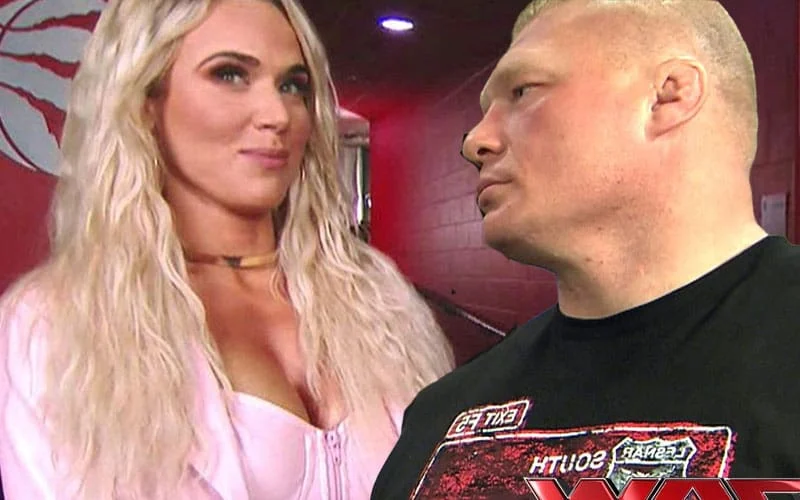
The public perception of Brock Lesnar has always been one of sheer, unadulterated physical dominance, a man whose presence in a wrestling ring is defined by suplexes, sweat, and a terrifying level of intensity. To the average fan watching from home, Lesnar is the ultimate mercenary, a genetic freak who enters the arena to dismantle opponents and leaves just as quickly as he arrived. However, beneath the surface of the conqueror who ended The Undertaker’s undefeated streak at WrestleMania lies a sophisticated tactical mind that few outside the inner circles of the professional wrestling industry ever get to witness. This side of the multi-time heavyweight champion is rarely discussed in public forums, but CJ Perry, known to millions of fans as Lana, recently shed light on the profound intellectual contributions Lesnar makes behind the scenes. Her reflections offer a fascinating look at the nuances of sports entertainment and the level of detail that goes into crafting the segments that define a superstar’s career.
The story dates back to 2016, a pivotal year for the WWE landscape following the reintroduction of the brand extension. At the time, CJ Perry and her husband, the man then known as Rusev and now recognized globally as Miro, were establishing themselves as one of the most effective heel acts on the roster. Rusev was the formidable United States Champion, a powerhouse whose physical style was perfectly complemented by Perry’s commanding presence on the microphone as the Ravishing Russian. Despite their success, they were still in a phase of their careers where every night was a learning experience, especially when sharing the locker room with established icons. During a series of live events, specifically a notable stop in San Jose, the couple found themselves scheduled to work alongside Brock Lesnar. For any young performer, being placed in a program or even a short series of matches with Lesnar is a high-pressure situation, as the expectations for intensity and realism are significantly elevated when the Beast Incarnate is involved.
During this particular loop of shows, Perry was tasked with delivering a promo to set the stage for the physical confrontation between Rusev and Lesnar. In the high-stakes environment of a WWE production, even the non-televised live events are treated as essential training grounds for refining timing and character work. Perry found herself collaborating with Paul Heyman, the legendary advocate and creative mastermind who has been inextricably linked to Lesnar’s career for decades. Heyman, known for his unparalleled ability to craft narratives and sell a match through words, was offering Perry guidance on how to structure her verbal assault. It was during this collaborative session that something unexpected happened. Heyman turned to Lesnar, who was observing the process, and asked for his perspective on the material they had developed. For a man often portrayed as someone who cares little for the creative minutiae of the business, Lesnar’s response was a revelation to Perry.
Instead of offering a cursory nod or a simple approval, Lesnar took a moment to truly digest the content of the promo. He didn’t just look at the words on the page; he visualized the entire interaction through the lens of the live audience. Perry noted that Lesnar’s feedback was not about changing a word here or there, but about a fundamental shift in the psychological approach to the segment. He possessed an innate ability to predict how a crowd would react to a specific sentence or a certain tone of voice. Lesnar’s advice centered on the concept of anticipation. He understood that a promo is not just a monologue delivered to a silent room; it is a living, breathing conversation with thousands of people. He encouraged Perry to rethink her delivery, focusing on how she could manipulate the crowd’s energy by preparing for their inevitable interruptions and using those moments to strengthen her own position.
This level of insight is what industry veterans often refer to as ring psychology, a skill that separates the great performers from the merely good ones. It involves understanding the rhythm of a crowd and knowing exactly when to push and when to pull back. Lesnar’s ability to deconstruct a promo and rebuild it with a focus on audience manipulation showed Perry that his success was not merely a result of his collegiate wrestling background or his UFC pedigree. It was the result of a deep, calculated understanding of the art of performance. He saw the "pop"—the loud reaction from the fans—not as an end goal, but as a tool to be managed. This was a masterclass in the subtle nuances of the business, delivered by a man who many fans mistakenly believe relies solely on his muscles to get the job done.
The education did not end with the pre-show preparations. After the segment and the subsequent match between Lesnar and Rusev took place, Lesnar continued to mentor the young couple. Backstage, away from the prying eyes of the cameras and the roar of the San Jose crowd, Lesnar pulled Perry aside to provide a critique of her execution. This is a common practice in the wrestling world, where veterans often "take the temperature" of a segment once it is finished to help younger talent improve. However, the specific nature of Lesnar’s advice was what stayed with Perry for years to come. He pointed out a specific technical flaw in her timing, telling her that she was effectively "stepping on her own pop." In wrestling terminology, this means continuing to speak or moving on to the next beat of a segment before the audience has had a chance to fully react to the previous one.
By not allowing the fans to boo or cheer for a sufficient amount of time, a performer can inadvertently cut the legs out from under their own momentum. Lesnar’s advice was simple yet profound: wait. He told her to give the crowd the space they needed to express themselves, to let the chants build and the vitriol simmer before moving forward with her next point. This patience is one of the hardest things for a developing performer to master, as the instinct is often to rush through a script to avoid dead air. Lesnar, however, understood that dead air is only "dead" if the performer doesn’t know how to fill it with presence. By standing silent and soaking in the reaction, a heel like the Ravishing Russian could actually exert more control over the room than by shouting over the noise.
This experience significantly altered Perry’s view of Lesnar. Like many people, she had perhaps fallen into the trap of believing the on-screen persona of the silent, destructive force who cares only about his paycheck and his farm. The reality she discovered was a man who is arguably one of the smartest minds in the history of the industry. Lesnar’s brilliance lies in his efficiency; he knows how to get the maximum emotional response with the minimum amount of wasted movement. Whether it is a subtle shift in his facial expressions during a match or the way he paces himself during a beatdown, every action Lesnar takes is calculated to elicit a specific response. Perry realized that the "Beast" is a carefully constructed character, but the man behind the character is a meticulous architect of professional wrestling.
The impact of these lessons on Perry and Miro cannot be overstated. During their tenure as a duo in WWE, they became renowned for their ability to command an audience, a skill that was undoubtedly sharpened by the wisdom shared by Lesnar and Heyman. The ability to listen to a crowd and adjust a performance in real-time is what allows a character to stay relevant and engaging over a long period. For Perry, receiving this validation and constructive criticism from a top-tier attraction like Lesnar provided a massive boost in confidence. It reinforced the idea that every second spent in front of the curtain is an opportunity to tell a story, and that the space between the words is often just as important as the words themselves.
Furthermore, this story highlights the importance of the internal mentorship system that exists within professional wrestling. While there are formal training facilities like the WWE Performance Center, some of the most vital education happens on the road, in the locker rooms, and during the quiet moments before a house show begins. When a veteran of Lesnar’s stature takes the time to invest in the growth of younger talent, it ensures that the foundational principles of the business—psychology, timing, and crowd connection—are passed down to the next generation. Lesnar’s willingness to engage with Perry and Rusev shows a level of respect for the craft that contradicts the "mercenary" narrative that often follows him. He clearly cares about the quality of the product, understanding that a better performance from his opponents ultimately makes the entire show, and his own segments, more impactful.
In the years since those 2016 encounters, both Perry and Miro have moved on to new chapters in their careers, but the lessons learned in San Jose remain a cornerstone of their professional identities. For the fans, this revelation serves as a reminder that what we see on television is only a fraction of the reality. Behind every great match or memorable promo is a wealth of knowledge and a series of deliberate choices. Brock Lesnar may always be remembered as the powerhouse who dominated the ring with brute strength, but for those who have worked with him, he is also remembered as a scholar of the game. His ability to navigate the complexities of human emotion and audience behavior is a testament to his status as a true great in the industry. CJ Perry’s willingness to share this story provides a rare and valuable glimpse into the intellectual side of a man who usually lets his actions do the talking, proving once and for all that there is far more to the Beast than meets the eye. The art of the pause, the mastery of the moment, and the strategic anticipation of the crowd are the hallmarks of a genius at work, and Brock Lesnar has proven himself to be exactly that.